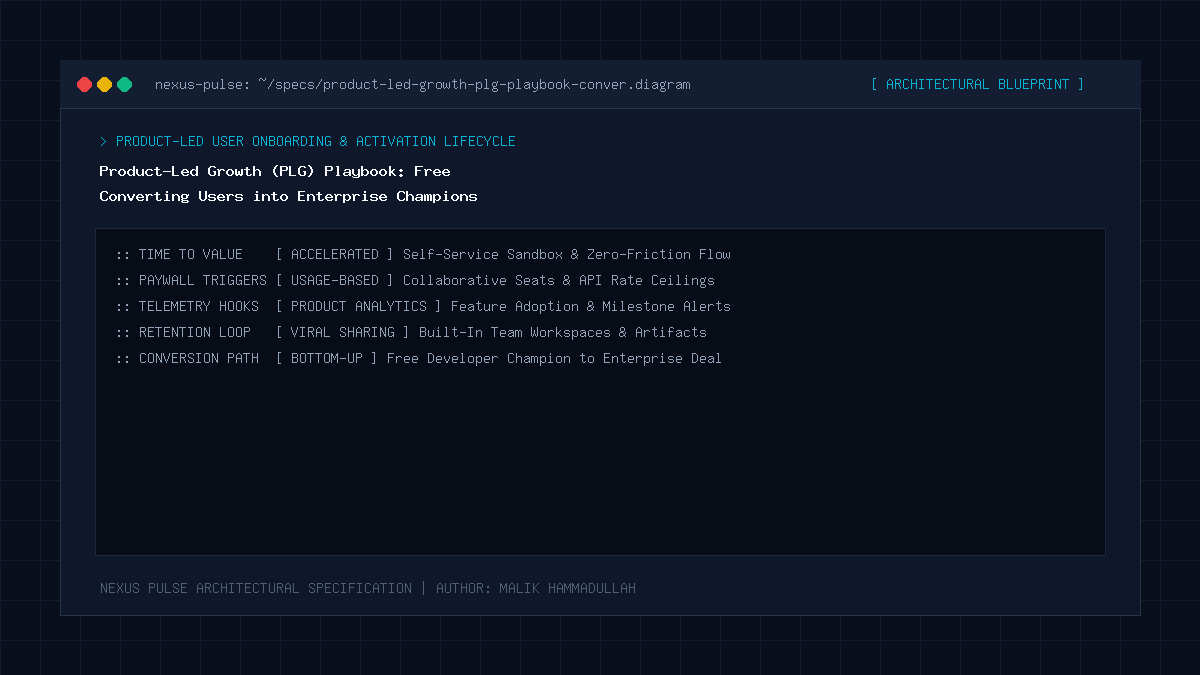
Product-Led Growth (PLG) relies on the software product itself to drive acquisition, retention, and expansion. By reducing time-to-value to under 60 seconds, adopting reverse-trial onboarding, and leveraging internal viral sharing loops, modern SaaS startups scale to tens of millions in ARR with minimal sales overhead.
Key Takeaways & Quick Summary
- Time-to-Value (TTV) must be compressed to under 60 seconds during initial user onboarding.
- The Reverse Trial model gives new signups full enterprise capabilities for 14 days before gracefully falling back to free tiers.
- Product-Qualified Leads (PQLs) convert at 3x to 5x higher rates than traditional marketing-qualified leads (MQLs).
- Bottom-up developer adoption naturally bypasses executive procurement gatekeepers through corporate expense card usage.
The Death of the “Book a Demo” Gatekeeper
In the previous generation of enterprise software sales, the standard go-to-market playbook was rigid and friction-heavy: hide pricing behind a “Contact Sales” button, require prospects to submit lengthy forms, endure a thirty-minute discovery call with a junior sales development rep, and wait weeks for a customized pilot sandbox.
In 2026, modern software buyers—particularly engineers, product managers, and digital founders—flatly refuse to endure this gauntlet. If a user cannot sign up with a Google or GitHub click, experience core product value within two minutes, and invite team members effortlessly, they bounce to a competitor who respects their time.
Product-Led Growth flips the traditional enterprise sales funnel on its head: let end users fall in love with the product for free, let it spread organically across internal teams, and monetize when the company requires enterprise governance, SSO, and compliance features.
Compressing Time-to-Value (TTV) to Sub-60 Seconds
The golden metric in PLG engineering is Time-to-Value (TTV)—the duration between a user landing on your homepage and experiencing their first meaningful “Aha!” moment of delight. Every onboarding screen, mandatory survey question, or unverified email confirmation link introduces friction where 20% to 40% of signups drop off forever.
State-of-the-art PLG products utilize smart defaults, pre-populated interactive sandbox templates, and zero-friction authentication to guide users directly into a fully functional workspace.
Rather than forcing users to configure settings from a blank canvas, modern SaaS tools present a living, interactive demo project that demonstrates immediate utility.
The Power of the Reverse Trial Onboarding Model
Traditional freemium models gate off the best capabilities, leaving free users with a crippled, underwhelming product experience. Conversely, traditional 14-day free trials force users to make a binary purchase decision before they have established sticky operational habits.
The Reverse Trial combines the strengths of both models: when a user signs up, they are automatically granted full access to all top-tier enterprise features (unlimited team seats, advanced analytics, API integrations) for 14 days with zero credit card required.
When the trial period concludes, their account gracefully downgrades to a generous, permanent free tier rather than locking them out of their data. Having experienced the sheer power of the full enterprise feature suite, teams organically upgrade to paid subscriptions as their organizational needs scale.
Identifying Product-Qualified Leads (PQLs) for Sales Expansion
PLG does not eliminate sales teams; it empowers them to act with surgical precision. Rather than cold-calling uninterested prospects, sales executives monitor Product-Qualified Leads (PQLs)—individual users or organizational clusters exhibiting clear high-intent behavioral telemetry.
When an engineering team creates 20 active projects in a week, invites 5 colleagues using company domain emails, or repeatedly hits team collaboration thresholds, the platform triggers an automated Slack alert for the enterprise sales lead.
The subsequent sales outreach is helpful, contextual, and consultative: “We noticed your team has 15 active developers collaborating on our platform. Would you like to consolidate billing onto an enterprise annual agreement with dedicated SOC2 compliance audit logs?” These contextual conversations close at 50%+ conversion rates.
Product-Led Growth (PLG) Playbook: Architecture & Technical Specifications Matrix
Sales-Led Growth (SLG) vs Product-Led Growth (PLG) Performance Benchmarks:
| GTM Dimension | Traditional Sales-Led Growth | Modern Product-Led Growth (2026) |
|---|---|---|
| Customer Acquisition Cost (CAC) | High ($2,000 – $15,000+ per customer) | Low to Negative (Viral self-serve loops) |
| Sales Cycle Duration | 3 to 9 months per deal | Self-serve instant, Enterprise in 3-6 weeks |
| User Onboarding Experience | Mandatory 45-min SDR demo calls | Instant self-serve with sub-60s TTV |
| Lead Qualification Mechanism | Marketing-Qualified Leads (MQL form fills) | Product-Qualified Leads (In-app usage data) |
| Net Dollar Retention (NDR) | 100% – 110% | 120% – 145%+ (Natural bottom-up seat expansion) |
Official Specifications & Primary Sources
Architectural specifications, model capabilities, and benchmark evaluations in this guide are cited from official documentation and published papers (verified as of October 2026):
- OpenView: OpenView Product-Led Growth Index & Benchmark
- Mixpanel: Mixpanel Product Analytics & Retention Benchmarks
- Reforge: Reforge Growth Frameworks & Retention Loops
Product-Led Growth (PLG) Playbook: Engineering Questions & Practical Considerations
Can B2B enterprise software really be sold product-led?
Yes. Industry titans like Slack, Figma, Datadog, and Atlassian proved that bottom-up user adoption scales into eight-figure enterprise enterprise agreements faster than traditional cold enterprise sales.
What is a Product-Qualified Lead (PQL)?
A PQL is an existing user or organization whose product usage metrics (e.g. daily active usage, team invites, feature adoption) indicate high propensity to convert to a paid enterprise tier.
How does PLG affect pricing strategy?
PLG requires transparent, self-serve tiering on the public website, allowing individual users and small teams to purchase with a credit card while maintaining a custom contact tier for high-volume enterprise contracts.
Join Our Official WhatsApp Channel
Get instant notifications for breaking AI developments, developer security guides, and tech intelligence directly on WhatsApp.

Recommended Reading