Quick Answer: Headless WooCommerce with Next.js decouples the customer-facing frontend from WordPress’s PHP monolithic rendering engine. The backend continues to leverage WooCommerce for robust order management, inventory control, and payment gateway routing, while a high-performance Next.js 15 application serves the storefront via WPGraphQL and the WooGraphQL extension. In 2026, this headless architecture slashes storefront latency by up to 80%, decouples marketing workflows from backend deployments, and delivers instantaneous sub-300ms checkout experiences without the bloat of traditional WordPress themes and heavy plugin scripts.
Key Takeaways & Quick Summary
- Decoupling WooCommerce with a Next.js App Router frontend eliminates frontend PHP bottlenecks while preserving existing catalog and order workflows.
- WPGraphQL provides strongly-typed, single-request data fetching that replaces fragmented REST endpoint calls with precise GraphQL queries.
- Server Actions and encrypted HTTP-only session cookies manage cart mutations and guest authentication without exposing API credentials to the client.
- Edge caching paired with webhook-driven on-demand cache revalidation ensures product catalogs remain fresh within seconds of a backend catalog edit.
1. The Enterprise Case for Decoupling WooCommerce
WooCommerce powers over 28% of all online stores globally. Its flexibility, mature plugin ecosystem, and deep payment gateway integrations make it unmatched for mid-market e-commerce operations. However, as catalog sizes expand beyond 5,000 SKUs and international traffic scales, the monolithic WordPress architecture encounters severe frontend constraints:
- Asset Overhead: Traditional WooCommerce themes load dozens of render-blocking stylesheets, jQuery plugins, and legacy cart scripts that depress mobile Google PageSpeed scores below 50.
- Database Lock Contention: Frontend page requests and checkout operations contend for the same MySQL database connections, degrading TTFB during seasonal flash sales.
- Deployment Rigidity: Minor frontend stylistic tweaks require deploying theme code directly onto the production server hosting customer payment records and inventory databases.
By transforming WooCommerce into a headless backend API and constructing the customer touchpoint using the Next.js App Router, engineering teams achieve total visual freedom, exceptional Core Web Vitals, and hardened security isolation.
2. Architectural Topology: Decoupled Components
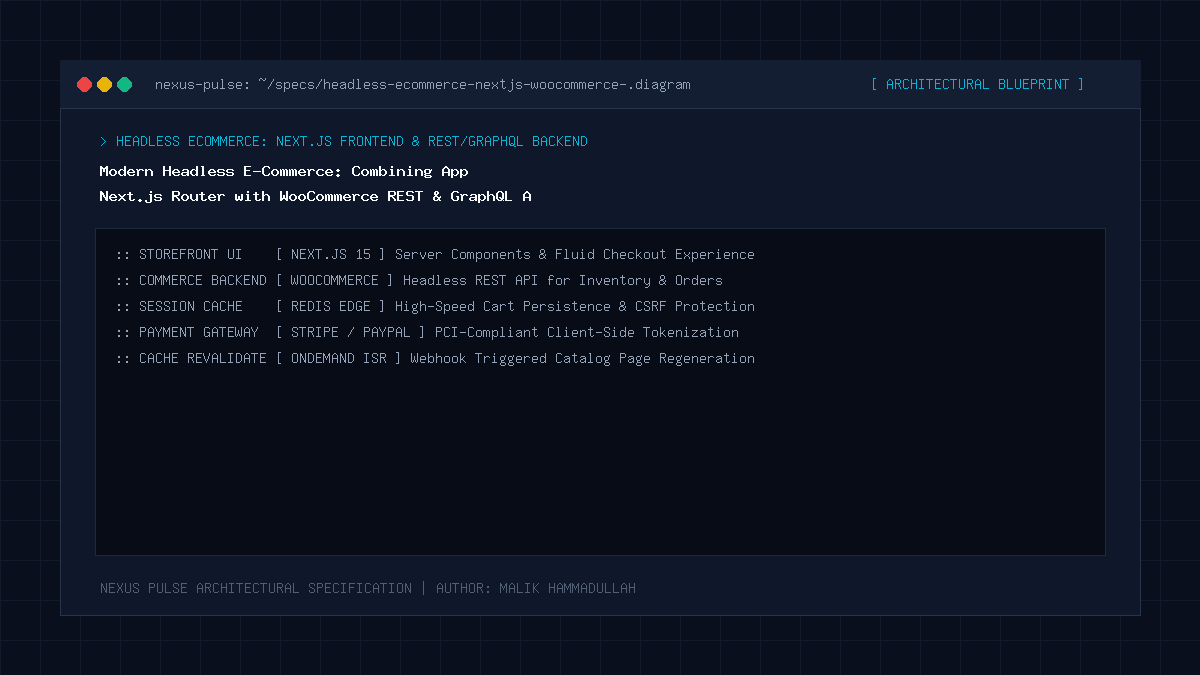
The enterprise headless stack is organized into four clearly separated architectural tiers:
- Presentation Tier (Next.js 15 / Vercel Edge): Renders React Server Components, handles customer interactions, manages cart state via Server Actions, and caches static product detail pages at global edge points.
- GraphQL API Gateway (WordPress / WPGraphQL): Translates incoming frontend GraphQL queries into optimized WordPress internal queries via the WooGraphQL schema provider, avoiding multiple REST round-trips.
- Transaction Engine (WooCommerce Core): Manages inventory state, tax rules, coupon calculations, customer profiles, and order dispatching.
- Payment Orchestration (Stripe / PayPal Elements): Processes tokens directly between the customer browser and the payment provider, ensuring the WordPress origin remains completely out of PCI-DSS scope.
3. Querying Product Data with WPGraphQL
Unlike the standard WooCommerce REST API, which returns bloated JSON payloads containing hundreds of unneeded fields, WPGraphQL lets Next.js fetch exactly the data required for rendering the product card:
// lib/graphql/queries/getProducts.ts
export const GET_FEATURED_PRODUCTS = `
  query GetFeaturedProducts(: Int = 12) {
    products(first: , where: { featured: true, stockStatus: IN_STOCK }) {
      nodes {
        id
        databaseId
        name
        slug
        ... on SimpleProduct {
          price
          regularPrice
          salePrice
        }
        image {
          sourceUrl
          altText
          mediaDetails {
            width
            height
          }
        }
      }
    }
  }
`;
4. Managing Cart Mutations with React Server Actions
A critical hurdle in headless architecture is maintaining cart continuity across guest and logged-in users. In Next.js 15, we utilize React Server Actions paired with encrypted HTTP-only session cookies to forward cart operations to WooCommerce securely:
// app/actions/cart.ts
"use server";

import { cookies } from "next/headers";
import { revalidateTag } from "next/cache";

const WOO_GRAPHQL_ENDPOINT = process.env.WOOCOMMERCE_GRAPHQL_URL!;

export async function addToCart(productId: number, quantity: number = 1) {
  const cookieStore = await cookies();
  const sessionToken = cookieStore.get("woocommerce-session")?.value;

  const mutation = `
    mutation AddToCart(: Int!, : Int!) {
      addToCart(input: { productId: , quantity:  }) {
        cart {
          total
          subtotal
          contents {
            itemCount
          }
        }
      }
    }
  `;

  const response = await fetch(WOO_GRAPHQL_ENDPOINT, {
    method: "POST",
    headers: {
      "Content-Type": "application/json",
      ...(sessionToken ? { "woocommerce-session": `Session ` } : {}),
    },
    body: JSON.stringify({
      query: mutation,
      variables: { productId, quantity },
    }),
  });

  const { data, headers } = await response.json();

  // Capture new session token if generated by WooCommerce
  const newSession = response.headers.get("x-wc-session");
  if (newSession) {
    cookieStore.set("woocommerce-session", newSession, {
      httpOnly: true,
      secure: process.env.NODE_ENV === "production",
      sameSite: "lax",
      maxAge: 60 * 60 * 24 * 7, // 7 days
    });
  }

  revalidateTag("cart-data");
  return data?.addToCart?.cart;
}
5. High-Concurrency Production Hardening
To operate a headless WooCommerce store reliably during high-volume commercial events, apply these production guardrails:
- Webhook-Driven Incremental Cache Invalidation: Configure WooCommerce action hooks (e.g.,
woocommerce_update_product) to dispatch a secure webhook to Next.js/api/revalidate?tag=product-[id], refreshing edge caches immediately when inventory or prices update. - Redis Object Caching on the WordPress Origin: Install Redis Object Cache Pro on the WooCommerce server to eliminate database queries for repeated WPGraphQL introspection schemas.
- Rate-Limiting API Endpoints: Apply Cloudflare WAF rate-limiting rules on
/graphqlto block credential-stuffing and coupon-enumeration bots before they reach the PHP application worker pool.
This comprehensive technical blueprint was researched and authored by Malik Hammadullah, Editor-in-Chief & Founder at NEXUS PULSE. Follow our engineering intelligence and connect with the author on Quora, GitHub, Twitter / X (@HammadMalik1772), and Instagram (@hammad_4757).
Sources & Official Documentation
Architectural specifications, model capabilities, and benchmark evaluations in this guide are cited from official documentation and published papers (verified as of October 2026):
- WooCommerce: WooCommerce REST API Official Documentation
- Next.js: Next.js Commerce Starter & Architecture
- WPGraphQL: WPGraphQL for WooCommerce Documentation
Join Our Official WhatsApp Channel
Get instant notifications for breaking AI developments, developer security guides, and tech intelligence directly on WhatsApp.

Recommended Reading