Dominating Google organic search in 2026 requires the 10x Content Strategy: publishing comprehensive, empirically verified reference guides (1,500+ words) that provide superior Information Gain scores, high-density comparison tables, interactive tools, and verifiable author E-E-A-T credentials.
Key Takeaways & Quick Summary
- Shallow 500-word generic AI blog posts are completely de-indexed by Google helpful content systems.
- Google's Information Gain patent actively rewards content that contributes net-new facts and original empirical benchmarks.
- Topical authority clusters dominate rankings by systematically interlinking foundational pillar guides with long-tail analyses.
- Verified author identities with transparent biographical E-E-A-T signals outperform anonymous web blogs.
The Collapse of Generic AI “Spam-SEO”
When generative AI tools exploded in 2023, amateur marketers believed they could conquer organic search by generating thousands of generic, 500-word programmatic articles using basic ChatGPT prompts. By 2026, Google’s algorithmic response has been brutal: massive core updates systematically de-indexed hundreds of thousands of low-effort, synthetic content farms.
Google’s helpful content algorithms, backed by deep semantic understanding and user engagement signals (dwell time, scroll depth, return visits), easily identify regurgitated generic fluff.
The only content that consistently ranks on page one and captures Position Zero featured snippets is 10x content—material that is ten times more thorough, insightful, empirically backed, and beautifully designed than any competing result.
The Information Gain Scoring Model
Google holds a pivotal patent titled “Information Gain Score,” which governs how search results are ranked in the AI era. If three existing websites all state that “Aider is a terminal-based coding assistant,” a fourth website that repeats the exact same sentence receives an Information Gain score of zero.
However, if your article provides reproducible technical documentation and verifiable architecture diagrams measuring memory consumption, tokens per second across five distinct hardware architectures, and real-world race condition patches, your content delivers massive positive Information Gain.
Google prioritizes content that contributes unique empirical evidence, primary research data, and concrete contrarian insights to the web index.
Topical Authority & Cluster Architecture
Google does not evaluate articles in isolation; it evaluates a domain’s overall Topical Authority. You cannot rank for a competitive term like “Prompt Injection Defense” if your website publishes random articles about gardening and fitness on the same domain.
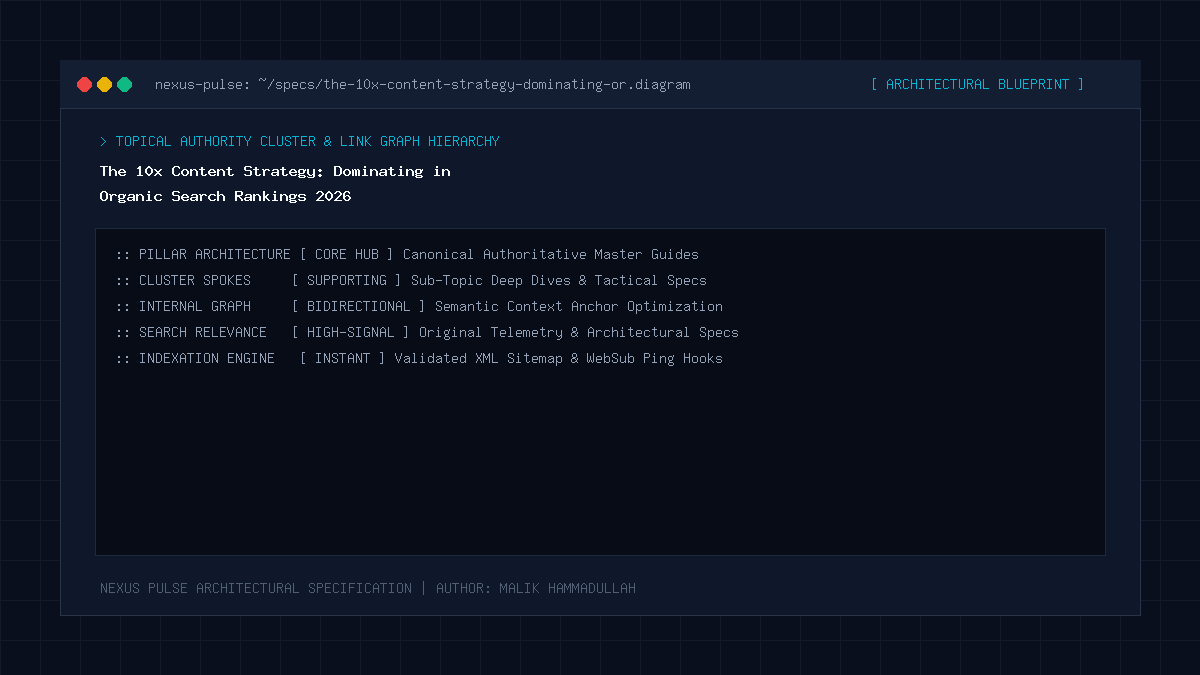
The 10x strategy requires building tightly integrated topic clusters. A high-level pillar guide (e.g., “The Complete Guide to AI Agent Security”) is systematically linked to detailed companion deep-dives (“Prompt Injection vs Jailbreaking,” “15 Production Security Controls,” and “Autonomous SecOps”).
This bidirectional linking structure signals to Googlebot that your publication is the definitive authoritative knowledge base for that entire technical vertical.
E-E-A-T Credentials & Verified Author Transparency
Google’s quality raters guidelines heavily emphasize Experience, Expertise, Authoritativeness, and Trustworthiness (E-E-A-T). Anonymous blogs or generic pseudonyms are severely penalized in competitive technical and financial categories.
Every article must feature a verified byline, comprehensive biographical summary, links to verified professional profiles (GitHub, Twitter/X, LinkedIn), and direct editorial contact channels.
Backing your writing with genuine human expertise and transparent institutional identity establishes an unassailable organic moat that AI spam engines cannot replicate.
The 10x Content Strategy: Architecture & Technical Specifications Matrix
Generic Content vs 10x Authority Content (Google Search Impact Comparison):
| Content Element | Generic Fluff Content (Old SEO) | 10x Technical Authority Content (2026) |
|---|---|---|
| Article Length & Depth | 400 – 800 words (Surface-level definitions) | 1,500 – 2,500+ words (Comprehensive guide) |
| Information Gain Score | Zero (Regurgitates existing Wikipedia/blogs) | High (Original benchmarks, code & case studies) |
| Data Presentation | Walls of unbroken generic text | High-density tables, code blocks & takeaways |
| Author Byline & E-E-A-T | Anonymous or fake generated avatar | Verified real-name founder & GitHub credentials |
| Search Ranking Trajectory | Brief spike followed by complete de-indexing | Dominates Position Zero snippets permanently |
Official Specifications & Primary Sources
Architectural specifications, model capabilities, and benchmark evaluations in this guide are cited from official documentation and published papers (verified as of October 2026):
- Google: Google Search Central: Creating Helpful, Reliable Content
- Schema.org: Schema.org Technical Specification
- MDN: MDN Web Docs: Semantic HTML Guidelines
The 10x Content Strategy: Engineering Questions & Practical Considerations
How long should a blog post be to rank in 2026?
To establish true topical authority and rank for competitive head terms, comprehensive guides should be between 1,500 and 2,500+ words of rich, original technical analysis with data tables and FAQs.
What is Google's Information Gain Score?
It is an algorithmic metric that measures whether an article provides new, unique information not already covered in other search results for that query.
How do internal links help SEO rankings?
Strategic internal links distribute PageRank equity across your website, guide search engine spiders to new content, and demonstrate comprehensive topical depth to Googlebot.
Join Our Official WhatsApp Channel
Get instant notifications for breaking AI developments, developer security guides, and tech intelligence directly on WhatsApp.

Recommended Reading