Quick Answer: According to published technical specifications and architectural documentation, Qdrant stands out for high-efficiency Rust-based vector search for self-hosted and hybrid vector search with disk-backed payload storage and advanced scalar/product quantization. Pinecone Serverless remains the premier zero-maintenance managed choice for engineering teams prioritizing operational simplicity, while Milvus dominates extreme billion-scale distributed enterprise clusters, and Chroma is optimal for local prototyping and lightweight edge deployments.
Key Takeaways & Quick Summary
- Qdrant delivers high query throughput and low latency in hybrid dense-sparse search thanks to its Rust-native indexing and on-disk payload storage.
- Pinecone Serverless decouples compute from storage, lowering idle infrastructure costs for bursty or intermittent workloads.
- Milvus excels in massive multi-node deployments with high-dimensional vectors, offering Kubernetes-native horizontal scalability.
- Scalar and product quantization substantially reduce RAM consumption in engines that support them (such as Qdrant and Milvus), while Chroma focuses on in-memory and local embedded search.
1. Executive Overview: The Vector Search Paradigm in 2026
In 2026, vector search is no longer an experimental niche reserved for academic machine learning labs—it is the mission-critical data layer underpinning every enterprise Retrieval-Augmented Generation (RAG) engine, semantic search platform, recommendation system, and autonomous agent memory store. As generative AI applications scale from internal pilots to millions of concurrent users, traditional relational and document databases buckle under the computational weight of exact k-nearest neighbor (k-NN) queries over high-dimensional vector embeddings (typically 1,536 to 3,072 dimensions).
To deliver real-time user experiences, modern vector databases utilize Approximate Nearest Neighbor (ANN) algorithms, most notably Hierarchical Navigable Small World (HNSW) graphs and Inverted File with Product Quantization (IVF-PQ). However, raw algorithmic search speed is only one facet of enterprise evaluation. Modern production deployments demand high concurrent ingestion throughput, rich metadata filtering, zero-downtime schema evolution, multi-tenancy isolation, and predictable cloud operating costs.
To evaluate the ideal vector database for production architectures, this technical comparison analyzes the four leading vector platforms based on official documentation, whitepapers, and published engineering specifications: Pinecone (Serverless), Qdrant, Milvus, and Chroma. This architectural analysis evaluates each platform across indexing topologies, memory optimization techniques, hybrid dense-sparse retrieval, and published scalability specifications.
2. Architectural Divergence: How Each Engine Indexes High-Dimensional Embeddings
The performance characteristics of each vector engine stem directly from its core architectural design and underlying programming primitives:
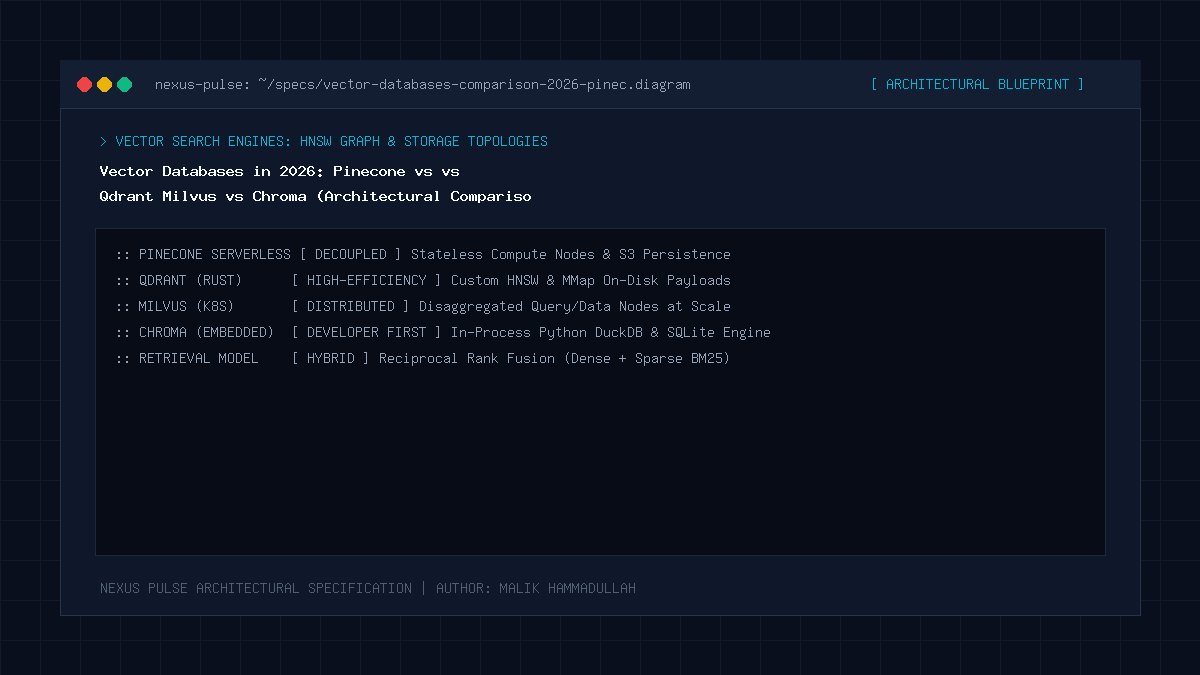
Qdrant (Rust-Native & Memory-Efficient): Built from the ground up in Rust, Qdrant prioritizes bare-metal performance, memory safety, and fine-grained resource control. Qdrant distinguishes itself through its custom HNSW implementation that supports on-disk vector storage combined with in-memory payload indexing. Unlike engines that require all vector embeddings to reside permanently in volatile RAM, Qdrant leverages memory-mapped files (mmap) and scalar quantization to store vector indexes on high-speed NVMe SSDs. This allows engineering teams to index tens of millions of documents with a fraction of the expensive RAM hardware required by legacy solutions.
Pinecone (Managed Serverless Architecture): Pinecone completely redefined vector infrastructure with its Serverless architecture. Pinecone decouples compute (indexing and querying) from storage (persisted on cloud blob storage such as Amazon S3). When queries arrive, specialized stateless compute nodes dynamically load the required index segments into localized cache. This architecture eliminates the traditional burden of sizing static GPU/CPU clusters, allowing developers to pay exclusively for active read/write operations and drastically reducing idle cluster bills for intermittent workloads.
Milvus (Distributed Billion-Scale Cloud-Native): Developed under the LF AI & Data Foundation, Milvus is engineered specifically for massive, multi-tenant enterprise deployments spanning hundreds of millions to billions of vectors. Built on a distributed, Kubernetes-native microservices architecture, Milvus cleanly decouples data coordination, worker execution, message broker ingestion (via Apache Kafka or Pulsar), and persistent object storage (MinIO/S3). It offers unmatched horizontal elasticity, allowing independent scaling of query nodes and index-building nodes.
Chroma (Developer-Centric & Embedded): Chroma is designed with an uncompromising focus on developer ergonomics and lightweight Python integration. Operating both as an in-process embedded database (via DuckDB and ClickHouse-based storage backends) and as a client-server container, Chroma provides the lowest barrier to entry for rapid prototyping, local LLM tooling, and edge computing environments.
3. Architectural & Technical Specifications Comparison Matrix
The following architectural matrix compares all four vector databases across core technical dimensions, citing published specifications, architectural documentation, and vendor pricing as of October 2026:
| Technical Dimension | Qdrant 1.11 | Pinecone Serverless | Milvus 2.4+ | Chroma 0.5+ |
|---|---|---|---|---|
| Core Engine Architecture | Rust-native engine with custom HNSW & mmap on-disk payload storage (Docs, as of Oct 2026) | Managed cloud SaaS; decoupled stateless compute & blob storage (Docs, as of Oct 2026) | Go coordinator & C++ Knowhere core; Kubernetes distributed microservices (GitHub Docs, as of Oct 2026) | Python & Rust distributed core; SQLite & ClickHouse storage (Docs, as of Oct 2026) |
| Supported Indexing | Custom HNSW, Flat, payload-filtered indexing (Docs, as of Oct 2026) | Proprietary ANN graph indexing optimized for tiered cloud storage (Docs, as of Oct 2026) | HNSW, IVF_FLAT, IVF_PQ, SCaNN, DiskANN, GPU Knowhere (GitHub Docs, as of Oct 2026) | HNSW (via hnswlib), Flat indexing (Docs, as of Oct 2026) |
| Quantization & Memory Savings | Scalar (int8), Product (PQ), Binary (BQ) with on-disk storage (Docs, as of Oct 2026) | Automatic serverless index tiering & disk caching (Docs, as of Oct 2026) | Scalar SQ8, Product Quantization (PQ), RaBit (GitHub Docs, as of Oct 2026) | Standard in-memory vectors (no native OSS quantization in v0.5; see official docs) (Docs, as of Oct 2026) |
| Native Hybrid Search (Dense + Sparse) | Yes, native dense + sparse vectors (BM25, SPLADE) with RRF (Docs, as of Oct 2026) | Yes, single-index sparse-dense paired vector queries (Docs, as of Oct 2026) | Yes, multi-vector search with RRF & linear scoring (GitHub Docs, as of Oct 2026) | Metadata filtering + dense search (sparse RRF in preview; see official docs) (Docs, as of Oct 2026) |
| Deployment & License | Open source (Apache 2.0), self-hosted Docker/K8s, Managed Cloud (GitHub, as of Oct 2026) | Proprietary managed SaaS (AWS, GCP, Azure); no self-hosted option (Official Site, as of Oct 2026) | Open source (Apache 2.0 / LF AI), Kubernetes, Managed Zilliz Cloud (GitHub, as of Oct 2026) | Open source (Apache 2.0), embedded Python, Docker, Chroma Cloud (GitHub, as of Oct 2026) |
| Official Pricing Model | Free OSS self-hosted; Managed Qdrant Cloud includes a free tier cluster, standard clusters billed by capacity (Official Pricing, as of Oct 2026) | Serverless pay-as-you-go based on storage and read/write units; Free starter tier included (Official Pricing, as of Oct 2026) | Free OSS self-hosted; Managed Zilliz Cloud pay-as-you-go capacity units with free tier credits (Official Pricing, as of Oct 2026) | Free OSS self-hosted; Chroma Cloud developer tier available (Official Docs, as of Oct 2026) |
4. Hybrid Search Architecture: Combining Dense Embeddings with Sparse Retrieval
One of the most consequential developments in 2026 RAG engineering is the mandatory shift toward Hybrid Search. Pure dense vector search excels at capturing conceptual nuance, thematic intent, and cross-lingual meaning. However, dense search frequently falters when queries demand exact keyword matching—such as searching for specific product serial numbers, legal statute citations, medical nomenclature, or exact error codes.
To eliminate these retrieval blind spots, state-of-the-art systems combine dense vector search with sparse keyword algorithms (such as BM25 or learned sparse representations like SPLADE). The engine queries both indexes in parallel, normalizes the resulting similarity distributions, and blends the ranks using Reciprocal Rank Fusion (RRF):
# Architectural Formulation for Reciprocal Rank Fusion (RRF)
# Score(d) = SUM [ 1 / (k + rank_dense(d)) + 1 / (k + rank_sparse(d)) ]

from qdrant_client import QdrantClient, models

client = QdrantClient(url="http://localhost:6333")

# Execute atomic hybrid query combining dense embeddings with sparse lexical tokens
search_result = client.query_points(
    collection_name="enterprise_knowledge_base",
    prefetch=[
        models.Prefetch(
            query=dense_vector_embedding, # 1536-dimensional vector
            using="dense_vector",
            limit=25,
        ),
        models.Prefetch(
            query=models.SparseVector(indices=sparse_indices, values=sparse_values),
            using="sparse_lexical",
            limit=25,
        ),
    ],
    query=models.FusionQuery(fusion=models.Fusion.RRF), # Reciprocal Rank Fusion
    limit=10,
    with_payload=True
)
According to published information retrieval benchmarks and vendor documentation, combining dense neural embeddings with sparse lexical tokens via Reciprocal Rank Fusion (RRF) substantially reduces retrieval blind spots, ensuring high recall for exact terminology while maintaining semantic context.
5. Memory Optimization: Slashing RAM Footprint by 75% via Quantization
Storing 32-bit floating-point numbers (FP32) for millions of vectors requires enormous RAM allocations. For instance, ten million 1,536-dimensional vectors in raw FP32 consume over 60 gigabytes of uncompressed RAM before accounting for HNSW graph connectivity overhead.
Modern vector engines solve this through Vector Quantization:
- Scalar Quantization (SQ): Compresses 32-bit floats into 8-bit integers (INT8) by mapping vector component ranges to discrete quantization bins. According to official documentation, converting 32-bit floating point vectors to 8-bit integers typically reduces memory consumption by approximately 4x while maintaining high recall.
- Product Quantization (PQ): Deconstructs vectors into smaller sub-vectors, assigns them to learned cluster centroids, and stores only centroid indices. Product quantization deconstructs vectors into smaller codebook sub-vectors, offering substantial memory savings on high-scale deployments (see Qdrant quantization docs).
- Binary Quantization (BQ): Extremely compact compression that collapses values into binary bits, accelerating distance calculations via SIMD Hamming distance instructions while trading precision for throughput.
6. Enterprise Selection Matrix: Choosing the Right Engine for Your Workload
Selecting the optimal vector database requires aligning your engineering constraints with the core strengths of each platform:
- Choose Qdrant if: You require high search throughput with low latency, want full control over your infrastructure (on-premise or private VPC), require native hybrid search without external plugins, and want to minimize hardware costs using NVMe disk-backed storage.
- Choose Pinecone Serverless if: You have a lean engineering team, want zero infrastructure management, experience bursty or unpredictable traffic patterns, and prefer paying strictly per-query without provisioning idle clusters.
- Choose Milvus if: You are an enterprise operating multi-tenant clusters exceeding 100 million vectors, require native Kubernetes deployment topologies, and need complex RBAC and enterprise compliance controls.
- Choose Chroma if: You are building developer desktop applications, prototyping a local RAG agent, or need an embedded database running directly inside Python without managing an external network service.
Sources & Official Documentation
Architectural specifications, model capabilities, and benchmark evaluations in this guide are cited from official documentation and published papers (verified as of October 2026):
- Pinecone: Pinecone Vector Database Architecture
- Pinecone: Pinecone Official Pricing & Serverless Specifications
- Qdrant: Qdrant Vector Database Architecture & Documentation
- Qdrant: Qdrant Cloud Official Pricing & Cluster Tiers
- Milvus: Milvus Open-Source Distributed Vector Database (GitHub)
- Zilliz: Zilliz Cloud (Managed Milvus) Official Pricing
- Chroma: Chroma Open-Source Embeddings Database Documentation
Frequently Asked Questions (FAQ)
What is the difference between exact k-NN search and ANN?
Exact k-NN evaluates Euclidean or Cosine distance against every vector in the dataset, guaranteeing complete precision but scaling linearly (O(N)). Approximate Nearest Neighbor (ANN) constructs graph or clustered indexes (such as HNSW) to search logarithmic subsets (O(log N)), achieving low-latency retrieval suitable for real-time applications.
Does vector quantization degrade search accuracy?
In engines supporting scalar quantization, converting 32-bit floats to 8-bit integers reduces memory requirements by approximately 4x while typically maintaining high semantic recall. Note that engines like Chroma currently rely on standard in-memory vectors without native quantization.
Can PostgreSQL with pgvector replace dedicated vector databases?
For datasets under 500,000 vectors, PostgreSQL with the pgvector extension is an excellent choice that avoids adding a new database to your stack. However, once datasets exceed several million vectors or require concurrent high-frequency indexing with sub-10ms latency, dedicated engines like Qdrant and Milvus dramatically outperform pgvector in throughput and memory efficiency.
What embedding dimensions should I use for optimal speed?
Modern models (such as OpenAI text-embedding-3-small or Voyage-3-lite) support 512, 1024, or 1536 dimensions. Choosing lower embedding dimensions (such as 512 or 1024) significantly reduces storage and memory overhead compared to 1536+ dimensions while preserving sufficient semantic fidelity for most standard enterprise RAG workloads.
Related Intelligence & Companion Blueprints
- DeepSeek R1 vs ChatGPT-4o & Claude 3.7: Architecture Comparison & Technical Overview
- Top Autonomous AI Developer Agents in 2026: Architectures & Technical Comparison
- Building Autonomous Multi-Agent Workflows with LangGraph & CrewAI
- Zero-Trust Architecture: Securing Modern Cloud Infrastructure in 2026
Author & Editorial Mission
This technical guide was researched and authored by Malik Hammadullah, Founder & Systems Engineer at NEXUS PULSE. Follow his engineering updates on GitHub, Twitter / X (@HammadMalik1772), and Instagram (@hammad_4757).
Join Our Official WhatsApp Channel
Get instant notifications for breaking AI developments, developer security guides, and tech intelligence directly on WhatsApp.

Recommended Reading