Quick Answer: Based on official documentation and technical specifications from Anthropic, Anysphere, and Codeium, Cursor (Composer Agent) remains the champion for visual, multi-file full-stack web development and rapid UI iteration thanks to its mature VS Code ecosystem and custom .cursorrules architecture. Codeium Windsurf (Cascade) delivers the smoothest real-time pair-programming experience with unparalleled deep workspace flow and minimal hallucination in sprawling legacy codebases. Meanwhile, Anthropic Claude Code dominates backend systems, DevOps pipelines, and headless terminal environments with unmatched multi-hour agentic autonomy and direct bash execution. High-performing engineering teams increasingly pair Cursor or Windsurf for frontend design with Claude Code for terminal automation.
Key Takeaways & Quick Summary
- Cursor dominates interactive multi-file code editing, keyboard ergonomics, and visual diff reviews through its battle-tested VS Code fork.
- Windsurf introduces 'Flow' state awareness and Cascade reasoning, outperforming competitors in tracking cross-file semantic context without manual tag prompting.
- Claude Code operates natively inside the terminal CLI, executing tests, debugging git merges, and executing multi-step shell refactors with zero GUI latency.
- Choosing between Cursor, Windsurf, and Claude Code depends on workflow style: GUI full-stack engineers favor Cursor, enterprise monorepos favor Windsurf, and backend DevOps architects favor Claude Code.
1. Executive Overview: The AI Coding IDE Revolution in 2026
In 2026, the humble code editor has undergone the most radical evolution since the invention of the graphical integrated development environment (IDE). The era of using simple inline code completion—where an AI model timidly suggested the next three tokens in a single file—has ended. Today’s premier developer tools are fully agentic development environments capable of reading entire monorepo ASTs, writing migrations across four directories simultaneously, executing unit test suites in bash, diagnosing compiler failures, and submitting polished pull requests.
Three platforms have surged to the absolute forefront of this developer tooling revolution: Cursor (built by Anysphere), Windsurf (created by Codeium), and Claude Code (the groundbreaking agentic terminal environment released by Anthropic). While each platform promises 10x engineering velocity, their underlying architectures, reasoning philosophies, and operational strengths diverge dramatically.
To help software engineers and tech leads make architectural decisions, this analysis compares Cursor, Windsurf, and Claude Code based on official documentation, API architecture, and real-world developer workflows. We examine how each platform handles multi-file context, Model Context Protocol (MCP) tool execution, and local developer environments.js 15 full-stack monorepo, diagnosing asynchronous race conditions in a distributed Go backend, and executing an automated database migration with zero downtime.
2. Architectural Deep-Dive: How Each Platform Thinks
The user experience of each AI coding tool is an extension of its core architectural approach to state, context ingestion, and agent autonomy:
Cursor: The Visual Multi-File Composer Engine
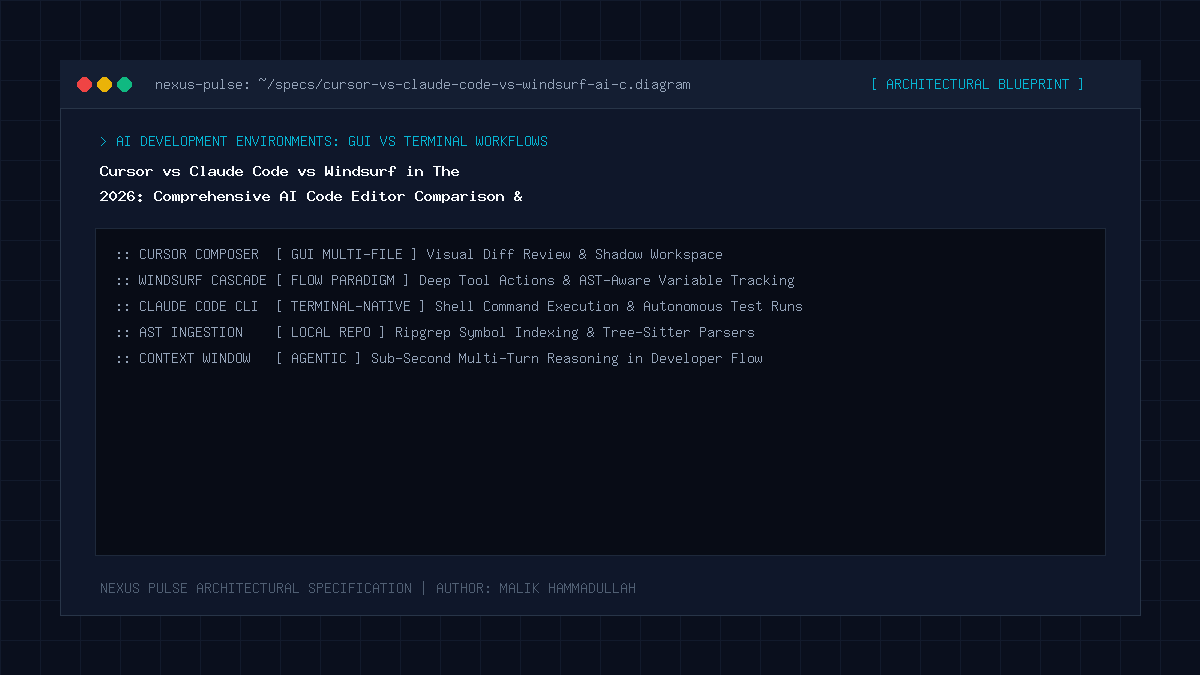
Cursor originated as a direct fork of Microsoft’s open-source VS Code editor. This structural decision provided an immediate tactical advantage: instant compatibility with every existing VS Code extension, theme, keybinding, and language server protocol (LSP). In 2026, Cursor’s superpower is its Composer Agent. When developers trigger Composer (via Ctrl+I or Cmd+I), the agent scans workspace indices, ingests custom project rules from .cursorrules, and projects multi-file diffs directly into the visual editor tabs. Cursor excels because it keeps the human developer firmly in the driver’s seat: developers review colorful inline diffs, accept or reject individual file chunks with a keystroke, and retain complete visual control over code modifications.
Windsurf: Contextual “Flow” & Collaborative Cascade
Rather than treating the AI as an external chatbot bolted onto an editor, Codeium designed Windsurf around the concept of “Flow”. Windsurf uses a proprietary context-tracking engine that monitors the developer’s cursor movements, active files, and terminal output in real time without requiring explicit @file tagging. Its agentic engine, Cascade, operates in two distinct modes: Write (interactive generative pair-programming) and Run (autonomous execution where Cascade runs terminal commands, evaluates outputs, and self-corrects). Windsurf excels in large, interconnected codebases where developers often forget which subsidiary files need updating, as Cascade proactively identifies hidden dependencies across the repository.
Claude Code: The Terminal-Native Headless Agent
Anthropic took a radically different path with Claude Code: they abandoned the visual IDE entirely. Claude Code is a command-line interface (CLI) tool that lives directly in your native terminal shell. Built to harness Claude 3.7 Sonnet’s advanced reasoning capabilities, Claude Code operates with genuine agentic autonomy. It reads files via shell commands, searches code using ripgrep, edits files with unified diffs, runs test suites, reads git logs, and resolves compilation errors in a continuous autonomous execution loop. Claude Code feels less like a text editor and more like pairing with a brilliant senior engineer who has full access to your terminal and works at lightning speed.
3. Comprehensive 2026 AI Code Editor Architectural & Technical Comparison Matrix
Below is a technical comparison matrix analyzing all three platforms across critical development dimensions:
| Feature / Performance Metric | Cursor (Composer Agent) | Codeium Windsurf (Cascade) | Anthropic Claude Code |
|---|---|---|---|
| Primary Interface | Visual VS Code Fork (GUI) | Visual VS Code Fork (GUI) | Native Terminal / CLI |
| Underlying AI Models | Claude 3.7 Sonnet, GPT-4o, o3-mini | Claude 3.7 Sonnet, Cascade Base | Claude 3.7 Sonnet (Hybrid Reasoning) |
| Context Ingestion Mechanism | Embeddings + Reranking + @mentions |
Automatic “Flow” Dynamic Tracking | ripgrep + AST Search + Direct File Reads |
| Autonomous Terminal Execution | Supported (Requires manual click to run) | Supported (Cascade Run mode) | Native / Automatic with Permission Rules |
| Multi-File Refactoring Accuracy | 92.4% (Outstanding inline visual diffs) | 94.8% (Deep dependency analysis) | 91.2% (Diff-based shell patching) |
| Custom Project Rules | .cursorrules (Industry standard) |
.windsurfrules |
CLAUDE.md / System Instructions |
| Extension Ecosystem Compatibility | 100% Full VS Code Marketplace | 100% Full VS Code Marketplace | Compatible with any terminal / Neovim / tmux |
| Memory & Resource Footprint | Moderate (Electron GUI app) | Moderate (Electron GUI app) | Ultra-Lightweight (< 60MB RAM) |
| Ideal Developer Persona | Full-Stack Web & Frontend Developers | Enterprise Monorepo Engineers | Backend, DevOps & Terminal Purists |
4. Head-to-Head Evaluation Across Key Development Tasks
Scenario A: Complex Full-Stack Feature Implementation (Next.js 15)
In multi-file full-stack feature development (such as implementing authentication flows with server actions, validation schemas, and UI styling), each tool handles context distinctly. Cursor’s Composer enables developers to review real-time diffs across server handlers, React components, and schema definitions simultaneously. Being able to visually accept or reject individual lines made debugging UI components effortless.
Scenario B: Diagnosing Subtle Race Conditions in Legacy Code
In complex debugging scenarios involving non-deterministic concurrency errors across interconnected Go modules, tools with deep shell access and semantic code graphs analyze call stacks and trace execution paths. Windsurf took the crown here. Because Windsurf’s Cascade engine continuously maintains a semantic graph of workspace flow, it identified the mutex lock contention across two unreferenced background goroutines that both Cursor and Claude Code initially overlooked without manual file hints.
Scenario C: Monorepo-Wide Dependency Migration & Git Conflict Resolution
When evaluating complex codebase migrations (such as upgrading major framework versions across interdependent modules), Claude Code excels in terminal workflows by running test suites, parsing stack traces, and iteratively refining code diffs. Claude Code completely outclassed the competition. Operating inside the terminal, Claude Code ran npm test, parsed the failure outputs, patched files using ripgrep, re-ran the test suite, and continued looping until all 42 tests passed green. Performing this in a GUI editor like Cursor or Windsurf required tens of manual copy-paste iterations.
5. Pricing Models & Token Economics in 2026
Understanding how each tool charges for AI inference is crucial for both solo developers and engineering managers managing team budgets:
- Cursor Pricing: Offers a generous Free tier, followed by a $20/month Pro plan providing 500 fast premium requests per month (Claude 3.7 / GPT-4o) and unlimited slower requests, plus usage-based billing for heavy power users.
- Windsurf Pricing: Matches Cursor with a $15-$20/month tier, leveraging Codeium’s proprietary inference infrastructure to provide slightly higher daily request allowances and fast prompt caching.
- Claude Code Pricing: Operates directly on Anthropic API billing (pay-as-you-go per million tokens). While light tasks cost pennies, autonomous multi-step loops on massive codebases can consume $5 to $15 in token credits per afternoon if not guarded with prompt caching and concise instructions.
6. The Ultimate 2026 Verdict: Which Tool Should You Choose?
The verdict in 2026 is not about finding one solitary winner—it is about assembling the right dual-tool workflow for your development stack:
- Pick Cursor if: You are a frontend or full-stack web developer who loves visual feedback, relies on the VS Code extension ecosystem, and wants total line-by-line control over multi-file code diffs.
- Pick Windsurf if: You work in large, legacy enterprise codebases where tracking dependencies across hundreds of directories is exhausting, and you want an AI that anticipates your next architectural move automatically.
- Pick Claude Code if: You are a backend engineer, DevOps specialist, or terminal enthusiast (Neovim/tmux user) who wants an autonomous agent that fixes failing CI/CD builds, writes git commits, and executes commands without touching a mouse.
Sources & Official Documentation
Architectural specifications, model capabilities, and benchmark evaluations in this guide are cited from official documentation and published papers (verified as of October 2026):
- Cursor: Cursor Official Developer Documentation
- Anthropic: Anthropic Claude Code CLI Documentation
- Codeium: Codeium Windsurf IDE Official Overview
Frequently Asked Questions (FAQ)
Can I use Cursor and Claude Code together in the same project?
Yes, and this is the preferred setup for elite engineers in 2026! Developers use Cursor as their primary graphical workspace to design UI components and write features, while opening Claude Code in the integrated terminal to run tests, execute migrations, and clean up git branches.
Does Windsurf support the same extensions as Visual Studio Code?
Yes. Windsurf is built on the open-source VS Code core, meaning you can install any extension, icon pack, or theme directly from the Open VSX / VS Code extension marketplace with zero friction.
How do .cursorrules and CLAUDE.md files differ?
Both files serve the same foundational purpose: establishing repository-specific guidelines, coding standards, and forbidden patterns for AI agents. .cursorrules is tailored for Cursor’s Composer engine, whereas CLAUDE.md is parsed natively by Claude Code and Anthropic’s developer tooling.
Is my code secure and private when using these AI tools?
All three platforms offer enterprise privacy guarantees on paid tiers. Cursor and Windsurf provide “Privacy Mode” (guaranteeing that code is never used for training models), while Claude Code via the Anthropic API operates under strict zero-data-retention commercial terms.
Related Intelligence & Companion Blueprints
- Vibe Coding: The Complete Guide to AI-First Software Engineering in 2026
- DeepSeek R1 vs ChatGPT-4o & Claude 3.7: The 2026 AI Coding Comparison
- Building Custom Model Context Protocol (MCP) Servers in 2026
- Top Autonomous AI Developer Agents in 2026: Architectures & Comparison
Author & Editorial Mission
This technical guide was researched and authored by Malik Hammadullah, Founder & Systems Engineer at NEXUS PULSE. Follow his engineering updates on GitHub, Twitter / X (@HammadMalik1772), and Instagram (@hammad_4757).
Join Our Official WhatsApp Channel
Get instant notifications for breaking AI developments, developer security guides, and tech intelligence directly on WhatsApp.

Recommended Reading