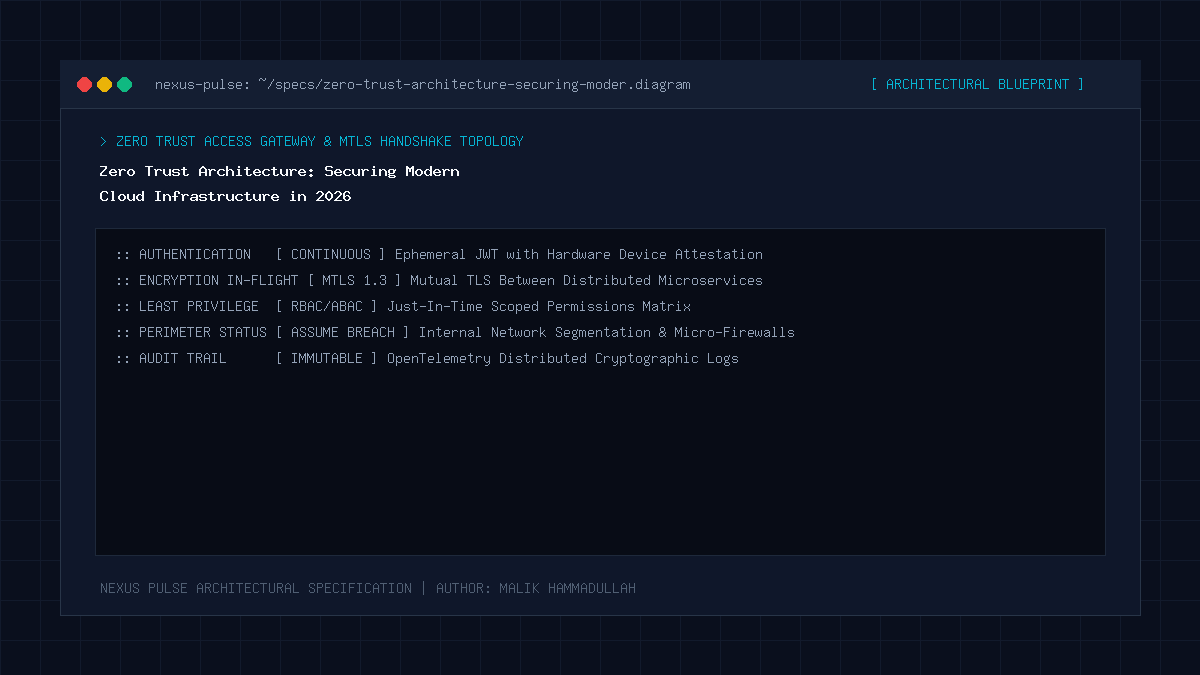
Zero Trust Architecture replaces the outdated castle-and-moat network perimeter with continuous cryptographic verification: never trust, always verify, enforce least privilege, and assume breach across every microservice and user session.
Key Takeaways & Quick Summary
- Traditional corporate VPNs and internal network trust models are fundamentally obsolete in modern cloud environments.
- Mutual TLS (mTLS) with short-lived X.509 certificates ensures cryptographic identity between every microservice.
- Software-Defined Perimeters (SDP) and Identity-Aware Proxies prevent unauthorized network enumeration.
- Continuous behavioral posture checking revokes access tokens dynamically when anomalous activity is detected.
The Collapse of the Castle-and-Moat Perimeter
For decades, enterprise IT security operated under the castle-and-moat security model: build a thick perimeter firewall around the corporate local area network (LAN), grant employees remote access via VPN, and assume that all traffic inside the internal network is benign.
In 2026, this model is catastrophic. With distributed multi-cloud architectures, hybrid remote workforces, third-party SaaS integrations, and containerized microservices, there is no longer an “inside” to protect. Once an adversary compromises a single developer laptop or unpatched staging container, a flat internal network permits unrestricted lateral movement across all database clusters and internal APIs.
Zero Trust Architecture (ZTA) eradicates implicit network trust, enforcing the core tenet: never trust, always verify.
The Core Pillars of Zero Trust Engineering
Zero Trust is not a commercial product; it is an architectural philosophy governed by NIST SP 800-207. It encompasses three non-negotiable principles:
Explicit Continuous Verification: Every request—whether originating from an executive laptop or an internal caching service—must authenticate and authorize against real-time contextual attributes (identity, device posture, location, time, and service reputation) before access is granted.
Least Privilege Access: Restrict user and service permissions strictly to the exact resources required for the immediate task, utilizing Just-in-Time (JIT) access grants and ephemeral session tokens.
Assume Breach: Architect systems under the assumption that adversaries are already present within internal network segments, minimizing blast radiuses through rigorous microsegmentation.
Implementing Microsegmentation & Service Mesh mTLS
In modern Kubernetes and cloud environments, microsegmentation is achieved through a service mesh (such as Istio, Linkerd, or Cilium). Rather than relying on static IP firewalls, service mesh sidecars inject mutual TLS (mTLS) into every inter-service TCP connection.
Each microservice receives a cryptographic identity via SPIFFE/SPIRE with an ephemeral X.509 certificate that rotates automatically every few hours. When Service A attempts to communicate with Service B, both endpoints perform mutual cryptographic handshake verification, ensuring that unauthorized or rogue pods cannot eavesdrop or inject malicious payloads.
Continuous Posture Checking & Ephemeral Access
Static username-and-password credentials and permanent API tokens are the primary attack vectors for modern credential stuffing attacks. Zero Trust environments replace them with Identity-Aware Proxies (IAPs) and FIDO2 passkeys.
If a developer’s laptop disables its disk encryption, fails an endpoint detection update, or exhibits anomalous geolocation shifts, the policy engine revokes all active OAuth/OIDC tokens instantly, isolating the device from production clusters before damage occurs.
Zero Trust Architecture: Architecture & Technical Specifications Matrix
Traditional Network Security vs Zero Trust Architecture (Architectural Comparison):
| Security Dimension | Traditional Castle-and-Moat | Zero Trust Architecture (2026) |
|---|---|---|
| Trust Model | Implicit trust based on network location (LAN/VPN) | Zero implicit trust; continuous cryptographic verification |
| Inter-Service Traffic | Unencrypted plaintext inside VPC subnets | Universal mutual TLS (mTLS) with rotating X.509 certificates |
| Lateral Movement | Trivial once perimeter firewall is breached | Blocked by microsegmentation & strict SPIFFE identities |
| Credential Lifespan | Long-lived API keys & static passwords | Short-lived ephemeral tokens (15-60 min) & FIDO2 passkeys |
| Access Decision | Static user group membership | Dynamic contextual risk assessment & device health posture |
Official Specifications & Primary Sources
Architectural specifications, model capabilities, and benchmark evaluations in this guide are cited from official documentation and published papers (verified as of October 2026):
- NIST: NIST SP 800-207: Zero Trust Architecture Standard
- CISA: CISA Zero Trust Maturity Model Version 2.0
- Cloud: Cloud Security Alliance (CSA) Enterprise Zero Trust Guidelines
Zero Trust Architecture: Engineering Questions & Practical Considerations
Is Zero Trust only for large enterprises?
No. Small startups and medium businesses can implement Zero Trust easily using modern tools like Cloudflare Zero Trust, Tailscale, and AWS Identity-Aware Proxies.
How does mTLS differ from standard TLS?
Standard TLS only verifies the identity of the server to the client. Mutual TLS (mTLS) verifies the cryptographic identity of both the client and the server simultaneously.
Does Zero Trust hurt developer productivity?
When properly implemented with seamless single-sign-on (SSO) and biometric passkeys, Zero Trust actually enhances developer experience by eliminating clunky corporate VPN clients.
Join Our Official WhatsApp Channel
Get instant notifications for breaking AI developments, developer security guides, and tech intelligence directly on WhatsApp.

Recommended Reading