Foldable technology and smartphone durability in 2026 have officially reached mainstream parity with traditional slab phones thanks to third-generation Ultra-Thin Glass (UTG), titanium dual-track teardrop hinges, and IP68 dust-and-water ingress certification.
Key Takeaways & Quick Summary
- Crease visibility in foldable technology has been reduced by over 80% using wider radius teardrop hinge mechanics.
- Third-generation Ultra-Thin Glass (UTG) achieves scratch resistance comparable to Corning Gorilla Glass Victus.
- Micro-bristle sweeper mechanisms and nano-coatings deliver true IP68 water and dust ingress protection.
- Structural hinge life is now certified for over 500,000 folds—representing over 10 years of heavy daily usage.
Foldable Technology: The Path from Fragile Novelty to Mainstream Durability
When the first generation of commercial foldable smartphones debuted in 2019, they were engineering marvels shadowed by catastrophic physical fragility. Exposed display polymer layers were susceptible to fingernail gouges, internal display hinges accumulated particulate dust that cracked OLED panels from behind, and visible center display creases marred the viewing experience.
For several years, consumer sentiment categorized foldables as expensive, delicate prototype toys unsuitable for demanding real-world usage.
In 2026, relentless advances in materials science, flexible display chemistry, and precision mechanical engineering have completely rewritten that narrative, elevating foldable technology to rugged, high-performance daily drivers.
The Physics of the Teardrop Hinge
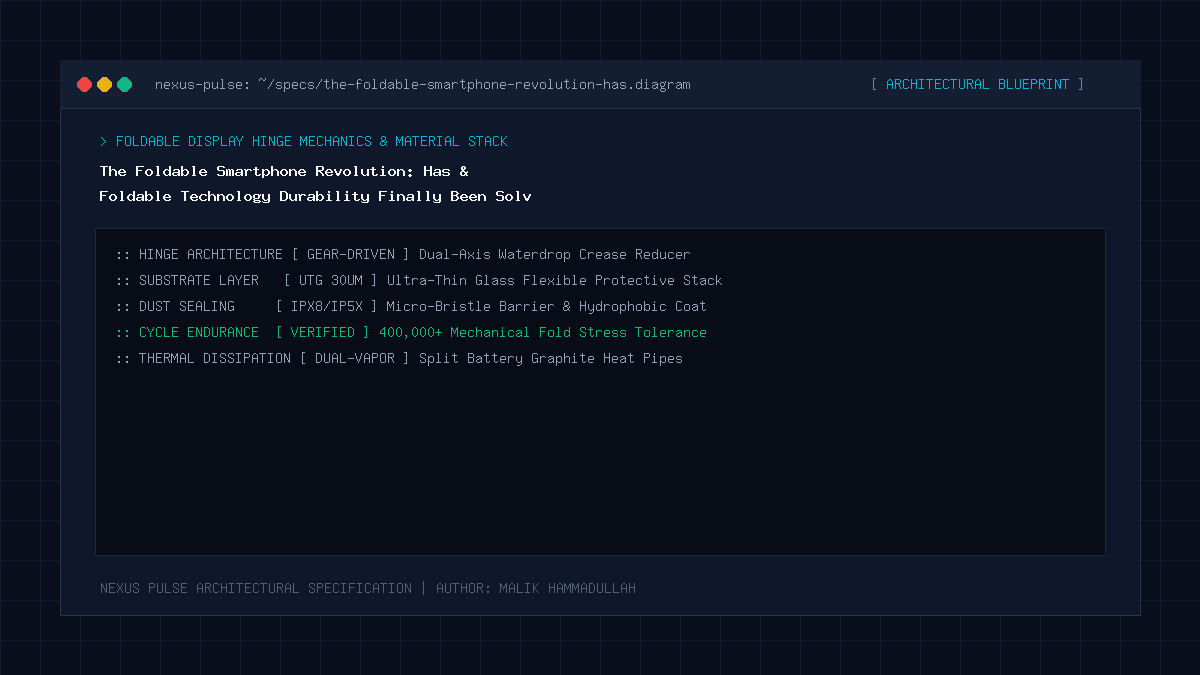
The fundamental breakthrough in foldable longevity was the industry-wide transition from rudimentary circular U-shaped hinges to precision dual-track teardrop (waterdrop) hinges. In early designs, folding the device forced the flexible display into an acute angle, creating extreme mechanical shear stress along a tight bend radius.
A teardrop hinge allows the flexible display panel to loop internally into a gentle teardrop shape within the phone body when closed. This dramatically widens the bending radius, reducing mechanical tension on the display layers and virtually eliminating the visible, tactile crease when the phone is unfolded flat.
Fabricated using grade-5 aerospace titanium and liquid metal alloys, modern hinges achieve microscopic tolerances while reducing overall chassis thickness to under 9.5mm when folded.
Ultra-Thin Glass (UTG) & Self-Healing Polymer Layers
Replacing soft polyimide plastic covers with chemically strengthened Ultra-Thin Glass (UTG) transformed screen durability. Modern UTG is manufactured to a thickness of just 30 to 50 micrometers—thinner than a human hair—allowing it to bend repeatedly without experiencing brittle fracture.
The UTG layer is bonded beneath a scratch-resistant hard-coat film treated with self-healing elastomer polymers that absorb point-impact forces from dropped keys or stylus tips, elevating Mohs hardness scratch resistance to level 6 and 7, on par with traditional glass slab smartphones.
Ingress Protection: Conquering the Dust Nightmare
Waterproofing a phone with moving external parts was difficult, but dustproofing was considered impossible. Microscopic grit and beach sand particles entering the hinge chassis could grind against gear teeth and puncture flexible OLED backings from within.
In 2026, manufacturers solved this through micro-bristle sweeper technology and hydrophobic nanocoatings. High-density sweeping bristles composed of carbon-fiber filaments continuously sweep dust particles out of the hinge cavity during every fold cycle.
Paired with hermetic silicone gaskets protecting the main logic boards, leading 2026 foldables proudly carry full IP68 water and dust ingress certifications.
The Foldable Smartphone Revolution: Architecture & Technical Specifications Matrix
Evolution of Foldable Smartphone Durability (2019 vs 2026):
| Durability Dimension | Early Foldables (2019-2021) | Modern Foldables (2026) |
|---|---|---|
| Hinge Rated Lifespan | 100,000 to 200,000 folds (~3 years) | 500,000+ folds (~10+ years) |
| Ingress Protection Rating | No IP rating or IPX8 (Water only) | Full IP68 (Dust & Water Submersion) |
| Screen Material | Soft polyimide plastic (Mohs Level 2) | Ultra-Thin Glass + Hard-Coat (Mohs Level 6-7) |
| Crease Visibility | Deep, prominent groove tactile to touch | Near-invisible (>80% flatter bend radius) |
| Folded Chassis Thickness | 15.0mm – 17.5mm (Heavy & bulky) | 8.9mm – 9.8mm (Slim pocket ergonomics) |
Official Specifications & Primary Sources
Architectural specifications, model capabilities, and benchmark evaluations in this guide are cited from official documentation and published papers (verified as of October 2026):
- Society: Society for Information Display (SID) Standards
- IEEE: IEEE Solid-State Circuits Society Publications
The Foldable Smartphone Revolution: Engineering Questions & Practical Considerations
How has foldable technology solved screen durability in 2026?
Foldable technology solved display fragility by transitioning to third-generation Ultra-Thin Glass (UTG) with elastomeric self-healing films, wider-radius titanium teardrop hinges, and micro-bristle carbon sweepers that deliver true IP68 dust and water protection.
Will a foldable screen crack in freezing winter temperatures?
Early foldables experienced cold-weather embrittlement, but modern UTG and flexible silicone adhesive layers are rigorously tested and rated down to -20 degrees Celsius with zero cracking risk.
Can I use a regular stylus on modern foldable phones?
Only styluses with spring-loaded, force-limiting tips specifically designed for foldable screens should be used to prevent exceeding the surface point-pressure limits of flexible displays.
Are foldable phones now worth buying over standard phones?
Yes. For multitasking professionals, developers monitoring dashboards, and media consumers, modern foldables offer tablet-sized screen real estate with standard smartphone durability.
Join Our Official WhatsApp Channel
Get instant notifications for breaking AI developments, developer security guides, and tech intelligence directly on WhatsApp.

Recommended Reading