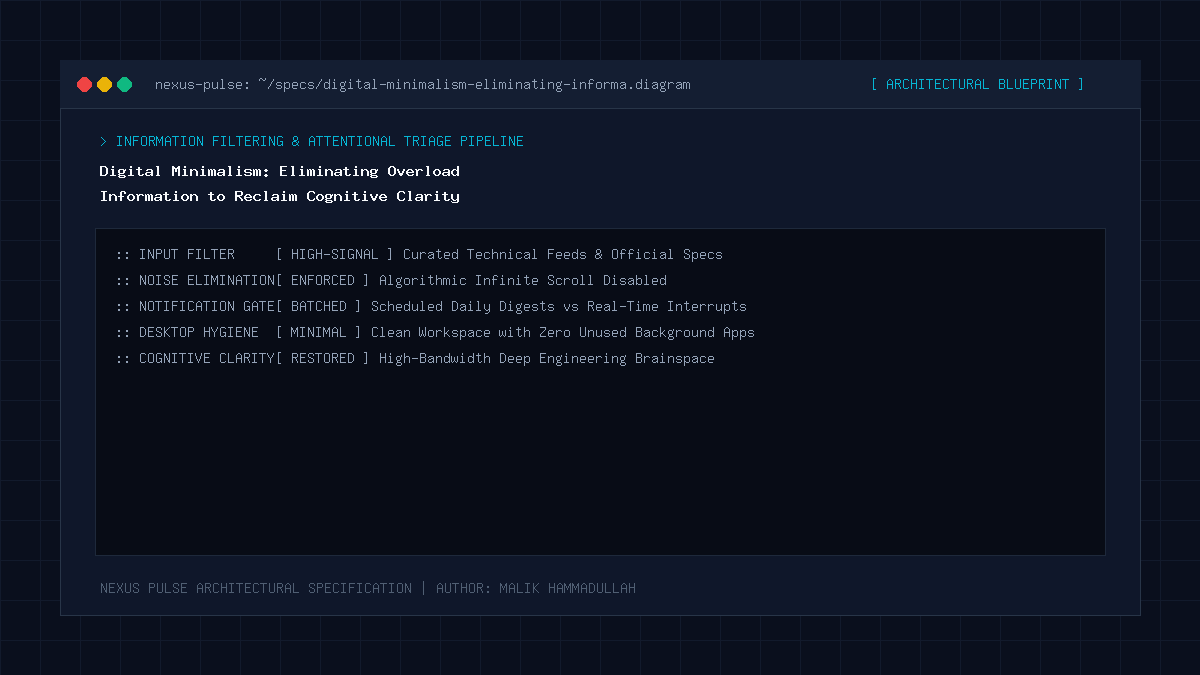
Digital minimalism is a philosophy of technology use in which you focus your online time on a small number of carefully selected activities that strongly support things you value, happily missing out on everything else to reclaim deep cognitive peace and creative clarity.
Key Takeaways & Quick Summary
- Information overload induces chronic cognitive fatigue, low-grade anxiety, and decision paralysis.
- The 30-Day Digital Declutter resets your dopamine baseline and breaks compulsory phone-checking habits.
- Audit your notifications: disable all push alerts except for real-time human communications from family and core team.
- Embrace intentional solitude: the human brain requires periods of zero cognitive input to process emotional state and synthesize ideas.
The Attention Extraction Economy
We live inside a multi-trillion-dollar attention economy engineered by the world’s most brilliant behavioral psychologists, data scientists, and machine learning engineers. Every social media algorithm, infinite scroll feed, clickbait headline, and push notification notification is mathematically optimized to exploit ancient evolutionary reward circuits in the human brain.
The consequence is severe: chronic digital exhaustion. Knowledge workers find themselves compulsively reaching for their smartphones during every micro-pause in their day—at a red light, in an elevator, or waiting in line for coffee—filling every quiet moment with an intoxicating flood of algorithmically curated stimuli.
This continuous sensory bombardment erodes deep thinking, breeds existential anxiety, and robs individuals of the quiet reflection necessary to cultivate genuine original thought.
The Philosophy of Digital Minimalism
Pioneered by computer scientist Cal Newport, digital minimalism is not an anti-technology Luddite crusade; it is a philosophy of radical intentionality. Minimalists recognize that modern technology is a miraculous tool, but they refuse to allow corporate algorithms to dictate how they spend the most finite resource they possess: their conscious attention.
Instead of asking, “Does this app offer any possible value?”, the minimalist asks, “Does this technology provide substantial, irreplaceable value that justifies the massive cognitive cost of allowing it into my mental sanctuary?”
By setting high hurdles for what tools earn access to their minds, minimalists reclaim hours of calm, creative focus every single day.
The 30-Day Digital Declutter Protocol
Gradual, incremental habit changes often fail because compulsive digital habits are deeply ingrained neural pathways. The definitive way to break free is the 30-Day Digital Declutter:
Step 1: Define Your Rules. Categorize all optional digital technologies (social media, news sites, video streaming, mobile games). Optional tools are defined as anything that will not cause you to lose your job or damage critical family relationships.
Step 2: Take a 30-Day Clean Break. Ban all optional technologies completely for thirty consecutive days. Delete apps from your phone, block domains on your computer, and experience the initial withdrawal discomfort.
Step 3: Reintroduce with Extreme Intentionality. At the end of the thirty days, reintroduce only tools that pass a strict utility audit, accompanied by explicit operational guardrails (e.g. “I only check Twitter from a desktop browser for 20 minutes on Friday afternoons”).
Reclaiming the Lost Art of Solitude
Throughout human history until recently, solitude was a natural component of daily life. Solitude is not about physical isolation; it is defined as a state of consciousness free from input from other minds.
When you walk in nature without earbuds, sit quietly on a train staring out the window, or wash dishes in silence, your brain’s default mode network (DMN) activates, weaving memories together, processing emotional grief, and sparking unexpected creative breakthroughs.
By eliminating the compulsive impulse to fill every second with podcasts, tweets, or videos, digital minimalists restore the rich, restorative stillness of an unhurried mind.
Digital Minimalism: Architecture & Technical Specifications Matrix
Compulsive Digital Consumer vs Intentional Digital Minimalist (Mindset Comparison):
| Life Dimension | Compulsive Digital Consumer | Intentional Digital Minimalist (2026) |
|---|---|---|
| Technology Adoption | Adopts any new app that offers any minor convenience | Rigorous utility hurdle; admits only essential tools |
| Phone Checking Frequency | 150 – 250 times per day (Compulsive reflex) | Intentional, batched checks (10-20 times per day) |
| Notification Settings | Buzzing continuously with dozens of app alerts | All notifications muted except urgent family calls |
| Evening & Bedtime Routine | Doomscrolling social media feeds until 1 AM | Screens off 1 hour before bed; reads physical books |
| Mental Clarity & Peace | Scattered, anxious, overwhelmed by news cycles | Calm, deeply focused, emotionally centered |
Official Specifications & Primary Sources
Architectural specifications, model capabilities, and benchmark evaluations in this guide are cited from official documentation and published papers (verified as of October 2026):
- Cal: Cal Newport: Digital Minimalism Philosophy
- Center: Center for Humane Technology: Principles of Humane Tech
- Oxford: Oxford University Internet Institute Research Publications
Digital Minimalism: Engineering Questions & Practical Considerations
How do I start digital minimalism without hurting my career?
Begin by turning off all non-human push notifications on your phone (social media, news, games). Keep essential work communications active during business hours, but establish firm evening shutdown rituals.
What should I do with the free time gained from digital minimalism?
Cultivate high-quality analogue leisure activities: read physical books, learn a musical instrument, engage in strength training, cook wholesome meals, and spend rich, in-person time with loved ones.
Is deleting social media completely necessary?
No. Many minimalists find great professional value in platforms like LinkedIn or Twitter/X by stripping the apps from their mobile phones and accessing them strictly via desktop browsers during scheduled, intentional windows.
Join Our Official WhatsApp Channel
Get instant notifications for breaking AI developments, developer security guides, and tech intelligence directly on WhatsApp.

Recommended Reading