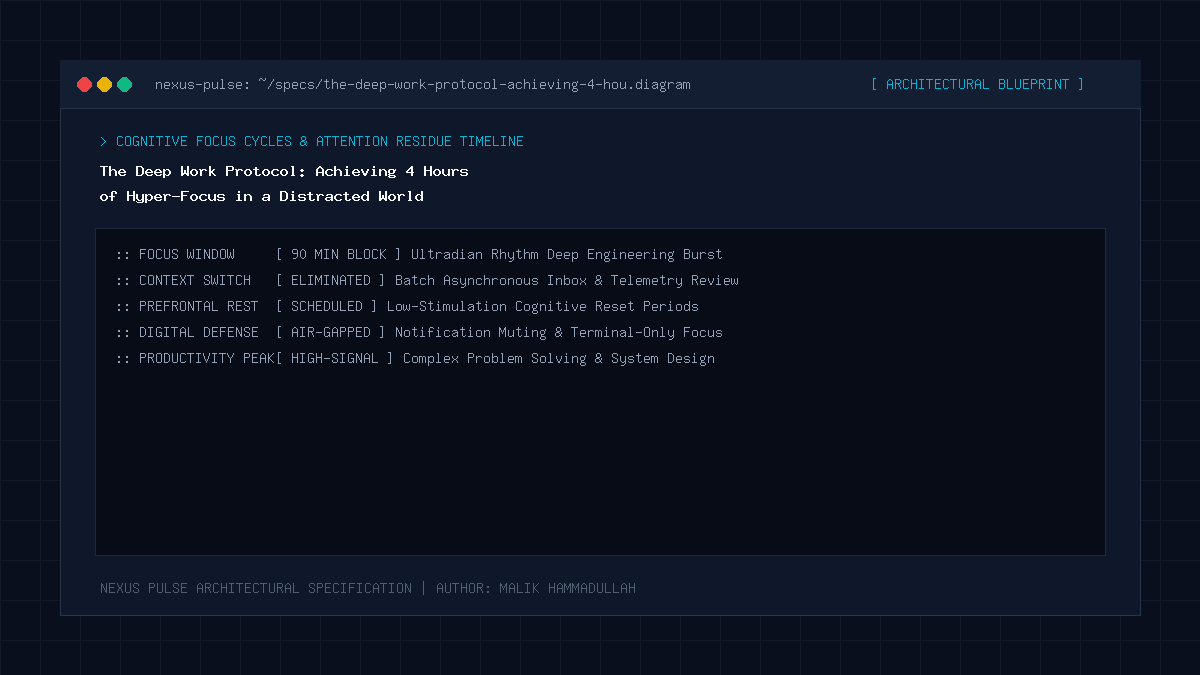
The Deep Work Protocol is a structured cognitive scheduling system that eliminates attention residue through physical environmental boundaries, strict digital notification shutdowns, and 90-minute ultradian rhythm sprints, enabling knowledge workers to produce 10x higher quality output in 4 hours than average workers accomplish in 40.
Key Takeaways & Quick Summary
- Attention residue: checking a quick notification leaves a cognitive lag that impairs intellectual depth for up to 20 minutes.
- The human brain is biologically incapable of sustaining peak high-focus cognitive work for more than 4 hours per day.
- Structuring work around 90-minute ultradian biological cycles aligns focus with natural dopamine and acetylcholine rhythms.
- True high-performance requires aggressive boundary defense: treat deep work blocks as sacred, non-negotiable appointments.
The Epidemic of Fragmented Attention
In 2026, modern knowledge work has become an asynchronous battlefield. Software developers, founders, and creative architects are bombarded by an incessant barrage of Slack pings, WhatsApp messages, automated Jira updates, and social media dopamine triggers. The average knowledge worker checks communication channels every six minutes, fragmenting their consciousness into a state of chronic distraction.
This continuous partial attention destroys the ability to perform high-leverage cognitive work. Complex tasks—such as designing a distributed database consensus protocol, authoring a novel compiler optimization, or formulating an enterprise business strategy—require holding deep, multi-layered mental models in working memory.
Every interruption shatters this mental palace, requiring 15 to 25 minutes of painful cognitive effort just to rebuild the lost context. The Deep Work Protocol is the antidote to this modern cognitive crisis.
The Neurobiology of Attention Residue
Pioneered by business professor Sophie Leroy and popularized by Cal Newport, the concept of “attention residue” explains why multitasking is a dangerous myth. When you switch your focus from writing an algorithmic code function to glancing at a quick Slack notification for 10 seconds, your attention does not switch cleanly.
A significant portion of your brain’s prefrontal cortex remains stuck processing the unfinished social context of the message: “Did my boss sound annoyed? When should I reply?”
This lingering attention residue diminishes cognitive bandwidth, degrades logical deduction capabilities, and increases code error rates. True intellectual breakthroughs require extended stretches of zero attention residue.
The 90-Minute Ultradian Rhythm Sprint
Human alertness and cognitive stamina naturally oscillate in biological cycles called ultradian rhythms, lasting approximately 90 to 120 minutes. Rather than attempting to force eight hours of continuous grinding, the Deep Work Protocol structures the day into two distinct 90-minute focus sprints:
Sprint 1 (Morning Peak): Conducted immediately after morning wakefulness, this 90-minute block is reserved for the single hardest, most intellectually demanding task of the day (e.g., core system architecture or complex bug resolution). All communication tools are physically disconnected.
The Decompression Interval: A mandatory 30-minute cognitive reset involving light walking, hydration, or meditation—strictly zero screens or email checks.
Sprint 2 (Late Morning): A second 90-minute sprint dedicated to secondary deep tasks (e.g., code review, documentation authoring, or refactoring).
Completing these two sprints delivers three hours of pure, undistracted deep work—more tangible intellectual progress than an entire week of distracted busywork.
Environmental Architecture & Boundary Defense
Relying on willpower to resist digital distractions is a losing strategy. The human brain is evolutionarily wired to seek novel stimuli and social affirmation. Elite performers engineer their physical and digital environments to make distraction physically difficult.
This entails placing smartphones in another room during focus sprints, utilizing browser extensions to block distracting web domains at the hosts file level, and establishing explicit asynchronous communication contracts with colleagues: “I check and respond to Slack at 1:00 PM and 4:30 PM daily.”
The Deep Work Protocol: Architecture & Technical Specifications Matrix
Shallow Fragmented Work vs Deep Work Protocol (Performance Comparison):
| Work Dimension | Standard Shallow Work (Default) | The Deep Work Protocol (2026) |
|---|---|---|
| Daily Unbroken Focus Time | Less than 30 consecutive minutes | 3 to 4 hours of pure, unbroken flow |
| Interruption Frequency | Every 6 to 10 minutes (Slack/Email) | Zero during active 90-minute sprints |
| Attention Residue Level | Chronic, severe cognitive exhaustion | Minimal; working memory fully dedicated |
| Quality of Intellectual Output | Mediocre, bug-prone, derivative | Exceptional, innovative, durable craftsmanship |
| End-of-Day Mental State | Exhausted, anxious, feeling unproductive | Energized, accomplished, clear mental shutdown |
Official Specifications & Primary Sources
Architectural specifications, model capabilities, and benchmark evaluations in this guide are cited from official documentation and published papers (verified as of October 2026):
- Cal: Cal Newport: Deep Work Research & Rules for Focused Success
- American: American Psychological Association (APA): Multitasking & Cognitive Cost
The Deep Work Protocol: Engineering Questions & Practical Considerations
Can someone really do deep work for 8 hours a day?
No. Decades of cognitive science research demonstrate that even world-class musicians, chess grandmasters, and mathematicians max out at approximately 4 hours of true deep focus per day. The rest of the day should be reserved for light administrative tasks and recovery.
How do I handle a boss who demands immediate Slack responses?
Communicate proactively: “I am dedicating 9am to 11am to solving our critical payment gateway architecture. I will be fully available on Slack starting at 11am. If there is an actual production outage, call my cell.”
What tools help maintain deep focus?
Physical noise-canceling headphones, website blockers like Freedom or Cold Turkey, and dedicated distraction-free text editors.
Join Our Official WhatsApp Channel
Get instant notifications for breaking AI developments, developer security guides, and tech intelligence directly on WhatsApp.

Recommended Reading