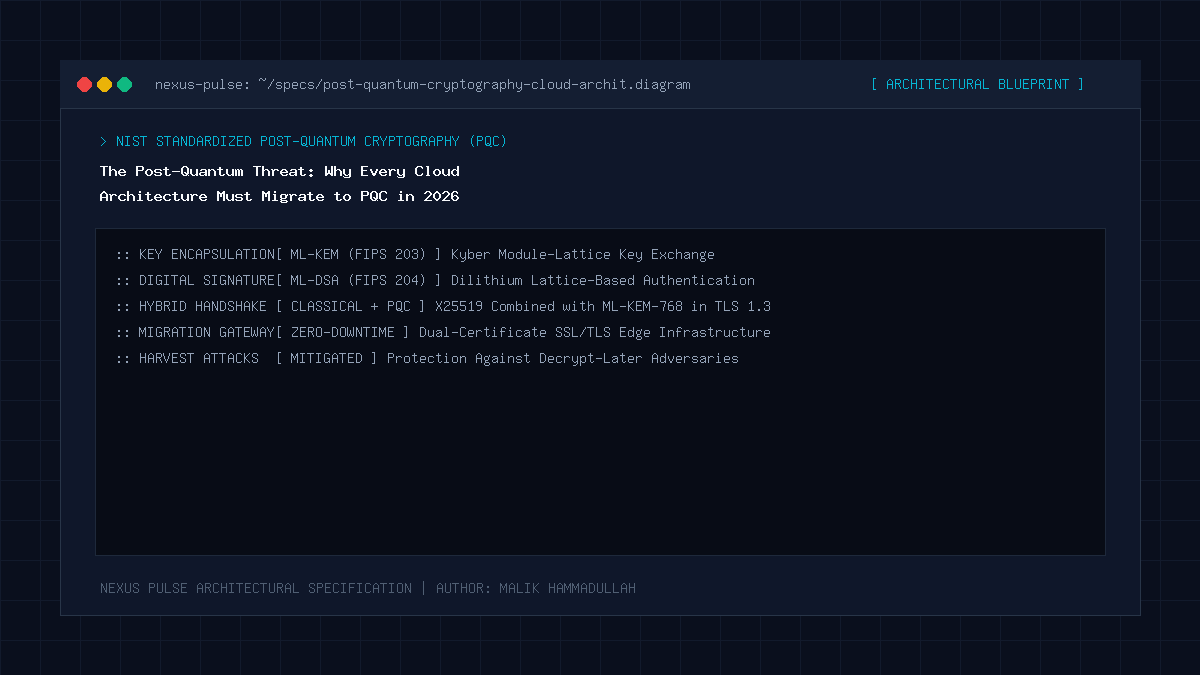
Every cloud architecture in 2026 must migrate to Post-Quantum Cryptography (PQC) using NIST-standardized lattice algorithms (FIPS 203 ML-KEM and FIPS 204 ML-DSA) to prevent state-sponsored adversaries from executing Harvest Now, Decrypt Later attacks against recorded TLS traffic.
Key Takeaways & Quick Summary
- Nation-state adversaries are actively intercepting and storing encrypted enterprise cloud traffic today.
- Shor's algorithm running on a cryptographically relevant quantum computer (CRQC) will break RSA and ECC completely.
- NIST finalized FIPS 203 (ML-KEM), FIPS 204 (ML-DSA), and FIPS 205 (SLH-DSA) as the official post-quantum standards.
- Hybrid key exchange (X25519 + ML-KEM-768) provides immediate quantum resistance without sacrificing classical security.
The Harvest Now, Decrypt Later (HNDL) Reality
For decades, cybersecurity architects treated quantum computing as a distant theoretical concern reserved for physics research labs. In 2026, that complacency has become a fatal enterprise vulnerability. The primary threat facing modern cloud architectures is not that quantum computers will crack active live sessions today; it is the reality of Harvest Now, Decrypt Later (HNDL).
Adversarial nation-states and well-funded cyber syndicates are actively tapping submarine fiber-optic cables and compromising transit routers to record terabytes of encrypted enterprise communications. Corporate trade secrets, financial transactions, patient medical records, and classified diplomatic traffic are being archived in massive data lakes.
When a cryptographically relevant quantum computer (CRQC) becomes operational within the next several years, running Shor’s algorithm will factor the prime numbers of RSA and resolve the discrete logarithms of Elliptic Curve Cryptography (ECC) in a matter of seconds, exposing every archived byte of historical data.
NIST Standardization: The New Cryptographic Primitives
In response to the quantum cliff, the National Institute of Standards and Technology (NIST) finalized its official Post-Quantum Cryptography standards: FIPS 203 (ML-KEM / Module-Lattice-Based Key-Encapsulation Mechanism, formerly Kyber), FIPS 204 (ML-DSA / Module-Lattice-Based Digital Signature Algorithm, formerly Dilithium), and FIPS 205 (SLH-DSA / Stateless Hash-Based Digital Signature Algorithm, formerly SPHINCS+).
Unlike classical algorithms that rely on number-theoretic hardness assumptions, ML-KEM and ML-DSA are constructed on the mathematical hardness of lattice-based problems (such as the Learning With Errors problem in module lattices), which are provably intractable for both classical and quantum computers.
The 5-Phase Enterprise Migration Roadmap
Phase 1: Cryptographic Inventory Audit. Catalog every instance of RSA, ECDSA, and ECDH across your API gateways, microservices, SSL certificates, and database column encryptions using automated software composition analysis (SCA).
Phase 2: Hybrid TLS 1.3 Key Exchange. Configure your edge load balancers (Cloudflare, AWS ALB, Envoy) to support hybrid key exchange protocols (specifically X25519MLKEM768). This combines classical X25519 with post-quantum ML-KEM-768, guaranteeing that even if a flaw is found in the novel lattice mathematics, classical security guarantees remain rock-solid.
Phase 3: Public Key Infrastructure (PKI) Upgrade. Update internal root and intermediate Certificate Authorities (CAs) to support ML-DSA signatures.
Phase 4: Hardware Security Module (HSM) Firmware Updates. Transition dedicated hardware security appliances to post-quantum firmware.
Phase 5: Automated Continuous Cryptographic Verification in CI/CD pipelines.
Architectural Trade-offs: Latency & Key Sizes
Migrating to post-quantum cryptography introduces non-trivial engineering trade-offs. Post-quantum public keys, ciphertexts, and digital signatures are significantly larger than classical ECC equivalents. An ML-KEM-768 public key is 1,184 bytes, compared to just 32 bytes for an X25519 key.
These larger payloads can cause TLS handshake packets to exceed standard Maximum Transmission Unit (MTU) packet sizes (1,500 bytes), causing TCP packet fragmentation and adding 10-25ms of latency to initial connection negotiations. Systems engineers must optimize TCP window sizes, utilize modern HTTP/3 (QUIC) protocols, and enforce persistent connection pooling to mitigate handshake overhead.
The Post-Quantum Threat: Architecture & Technical Specifications Matrix
Classical vs Post-Quantum Cryptographic Algorithms (Technical Parameter Comparison):
| Algorithm | Type | Quantum Security Level | Public Key Size | Ciphertext/Signature Size |
|---|---|---|---|---|
| RSA-3072 | Classical Key Exchange / Sig | Broken by Shor’s Algorithm | 384 Bytes | 384 Bytes |
| ECDSA P-256 | Classical Digital Signature | Broken by Shor’s Algorithm | 64 Bytes | 64 Bytes |
| X25519 | Classical Key Exchange | Broken by Shor’s Algorithm | 32 Bytes | 32 Bytes |
| ML-KEM-768 (FIPS 203) | Post-Quantum Key Exchange | NIST Level 3 (Quantum Proof) | 1,184 Bytes | 1,088 Bytes |
| ML-DSA-65 (FIPS 204) | Post-Quantum Digital Signature | NIST Level 3 (Quantum Proof) | 1,952 Bytes | 3,309 Bytes |
| SLH-DSA-128 (FIPS 205) | State-Free Hash Signature | NIST Level 1 (Quantum Proof) | 32 Bytes | 7,856 Bytes |
Official Specifications & Primary Sources
Architectural specifications, model capabilities, and benchmark evaluations in this guide are cited from official documentation and published papers (verified as of October 2026):
- NIST: NIST Post-Quantum Cryptography Selected Standards (FIPS 203, 204, 205)
- IETF: IETF Post-Quantum TLS 1.3 Key Exchange Drafts
The Post-Quantum Threat: Engineering Questions & Practical Considerations
When will a quantum computer break RSA encryption?
While exact timelines vary, top quantum physicists and national intelligence agencies estimate a cryptographically relevant quantum computer will emerge between 2029 and 2033. However, HNDL attacks require migrating today.
What is a hybrid key exchange in TLS 1.3?
A hybrid key exchange negotiates a shared encryption secret using both a classical algorithm (like X25519) and a post-quantum algorithm (like ML-KEM) simultaneously, ensuring security even if one method fails.
Will post-quantum cryptography slow down my website?
With modern HTTP/3 connection reuse and TLS session resumption, the performance impact of post-quantum handshakes is negligible for end users (under 5 milliseconds).
Join Our Official WhatsApp Channel
Get instant notifications for breaking AI developments, developer security guides, and tech intelligence directly on WhatsApp.

Recommended Reading