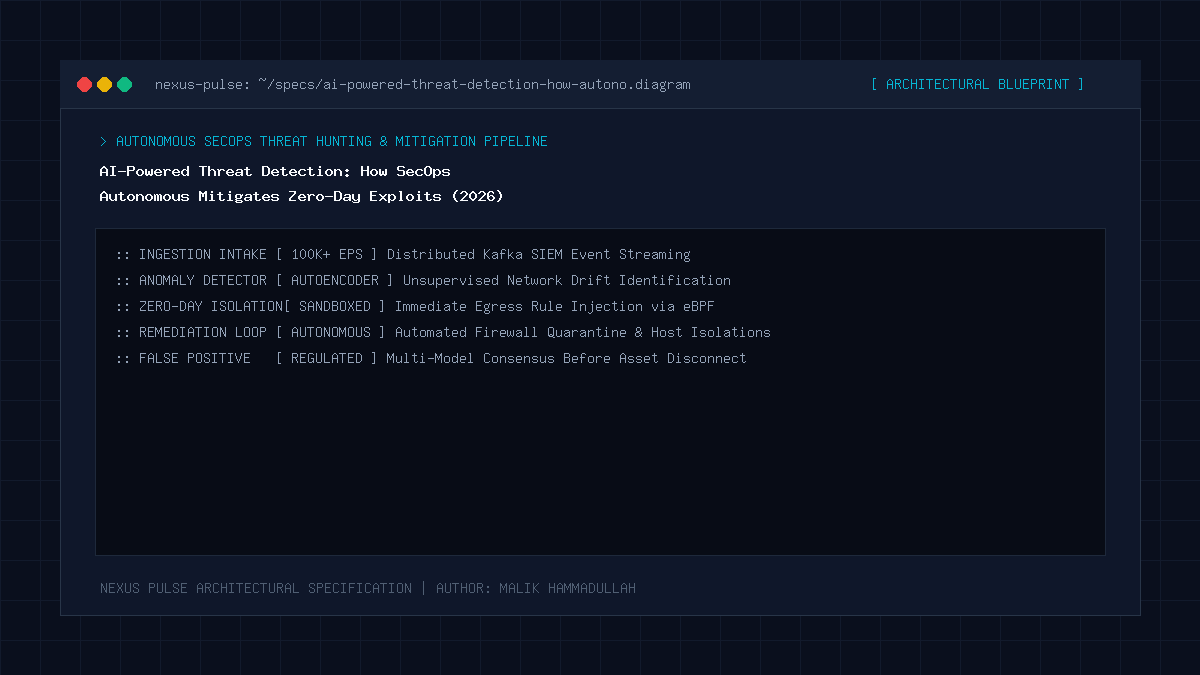
Autonomous SecOps platforms combine eBPF low-level kernel telemetry with real-time transformer anomaly detection, automatically isolating compromised containers and revoking session tokens within seconds to neutralize zero-day exploits before human analysts even receive an alert.
Key Takeaways & Quick Summary
- Traditional signature-based antivirus and rule-based SIEMs are powerless against novel zero-day exploits.
- eBPF kernel tracing provides deep, unforgeable visibility into process executions and network socket connections.
- Autonomous SecOps platforms analyze behavioral anomalies rather than static threat signatures.
- Automated SOAR playbooks isolate compromised cloud workloads in sub-second timeframes, shrinking dwell time to zero.
Autonomous SecOps & The Asymmetric Speed of Cyber Warfare
Modern cybersecurity is fundamentally a battle of latency. In 2026, sophisticated cyber adversaries utilize automated reconnaissance tools and generative AI to discover zero-day vulnerabilities in software dependencies, compile custom weaponized exploits, and achieve network lateral movement within minutes of initial breach.
In stark contrast, traditional Security Operations Centers (SOCs) rely on human security analysts drowning in thousands of low-fidelity alerts across fragmented SIEM dashboards. The industry average Mean Time to Detect (MTTD) and Mean Time to Remediate (MTTR) still spans days or weeks—an eternity when an automated exploit is executing memory dumping routines.
Autonomous SecOps reverses this asymmetry by delegating real-time detection, correlation, and initial containment to specialized machine learning models capable of acting at computational speed.
Behavioral Anomaly Detection vs Static Signatures
Traditional security tools look backward: they search network traffic and disk files for known threat signatures (hashes or byte patterns of past malware). When an adversary deploys a novel zero-day exploit or polymorphic code, signature-based defenses fail completely.
Autonomous SecOps relies on behavioral baseline modeling. Machine learning algorithms analyze normal operating baselines across every microservice: typical CPU execution cycles, memory allocation maps, child process spawn hierarchies, and normal outbound network endpoints.
When a web application container suddenly initiates an unauthorized outbound connection to a non-whitelisted IP address or spawns a bash shell from an unexpected daemon thread, the anomaly score spikes instantly, triggering immediate automated defensive countermeasures regardless of whether the exploit code has ever been seen before.
The Power of eBPF Kernel Observability
The foundational data engine powering autonomous threat detection in 2026 is extended Berkeley Packet Filter (eBPF). Operating directly within the Linux operating system kernel without requiring invasive daemon modifications, eBPF captures low-level syscalls, network socket lifecycles, and file descriptor modifications with microsecond precision.
Because eBPF runs in kernel space, even if an attacker gains root privileges inside a Docker container, they cannot disable or manipulate the eBPF event tracer. This guarantees unforgeable telemetry streams for downstream ML correlation engines.
Automated SOAR Playbooks & Blast Radius Containment
Detection without automated remediation is useless. Modern Security Orchestration, Automation, and Response (SOAR) engines execute deterministic playbooks the millisecond a critical anomaly is validated.
The autonomous system updates Kubernetes network policies to isolate the affected pod, creates an instantaneous snapshot of memory for forensic auditing, revokes all associated cloud IAM service credentials, and injects synthetic honeypot data to confound the attacker, all before alerting the on-call human incident commander.
AI-Powered Threat Detection: Architecture & Technical Specifications Matrix
Traditional Human SOC vs Autonomous AI SecOps (2026 Performance Metrics):
| Operational Metric | Traditional Human SOC | Autonomous AI SecOps (2026) |
|---|---|---|
| Mean Time to Detect (MTTD) | 14 to 36 hours | Sub-30 seconds (Real-time telemetry analysis) |
| Mean Time to Remediate (MTTR) | Days to weeks | Sub-60 seconds (Automated workload isolation) |
| Alert Fatigue Handling | High burnout; 40% of alerts ignored | Automated ML triage drops 98% of false positives |
| Zero-Day Resilience | Fails against unknown signatures | High (Detects anomalous behavioral patterns) |
| Telemetry Source | High-level application log dumps | Low-level eBPF kernel syscall & socket tracing |
Official Specifications & Primary Sources
Architectural specifications, model capabilities, and benchmark evaluations in this guide are cited from official documentation and published papers (verified as of October 2026):
- MITRE: MITRE ATT&CK Enterprise Matrix Framework
- OWASP: OWASP Top 10 for Large Language Model Applications
- NIST: NIST Cybersecurity Framework (CSF 2.0)
AI-Powered Threat Detection: Engineering Questions & Practical Considerations
What is Autonomous SecOps and how does it detect zero-day exploits?
Autonomous SecOps is an automated security operations architecture combining low-overhead eBPF kernel telemetry with behavioral machine learning models. It identifies anomalous system call patterns and automatically isolates compromised cloud containers within sub-minute intervals, mitigating novel zero-day threats before signature-based SIEMs can generate an alert.
Does autonomous SecOps replace human security engineers?
No. It eliminates alert fatigue and handles initial containment triage, allowing senior security engineers to focus on threat hunting, architecture hardening, and post-mortem analysis.
Can autonomous SecOps accidentally shut down production systems?
Modern platforms use progressive confidence thresholds: high-confidence attacks trigger immediate container isolation, while lower-confidence anomalies alert human operators with pre-compiled remediation recommendations.
What is eBPF in cybersecurity?
eBPF is a revolutionary Linux kernel technology that allows security programs to run safely inside the operating system kernel to observe all system calls, file operations, and network packets with zero performance overhead.
Join Our Official WhatsApp Channel
Get instant notifications for breaking AI developments, developer security guides, and tech intelligence directly on WhatsApp.

Recommended Reading