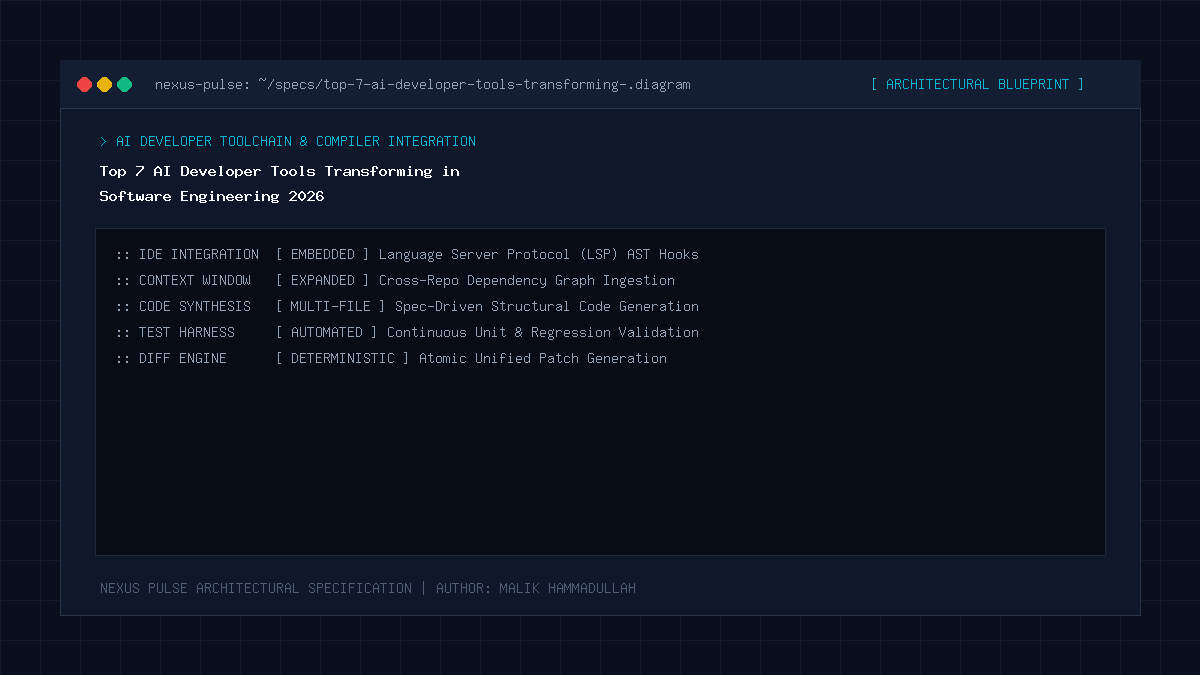
The top 7 AI developer tools in 2026 are Cursor, GitHub Copilot Workspace, Supermaven, v0 by Vercel, Devin, CodeRabbit, and DeepSeek Coder, ranked by AST context precision, latency, and full-stack velocity.
Key Takeaways & Quick Summary
- Modern developer tools index entire codebase abstract syntax trees (ASTs) rather than relying on naive text windows.
- Ultra-low-latency autocomplete (sub-50ms) with Supermaven and Cursor dramatically reduces developer cognitive friction.
- Generative UI platforms (v0) convert design intents into production-ready accessible React/Tailwind components in seconds.
- Automated AI code review tools (CodeRabbit) catch architectural regressions and memory leaks prior to human review.
The Evolution of the Developer Toolchain
Software engineering in 2026 has witnessed the complete reimagining of the integrated development environment (IDE). Where developers previously spent 60% of their working hours searching Stack Overflow, deciphering undocumented third-party libraries, and authoring repetitive boilerplate tests, next-generation AI developer tools have shifted the engineer’s role to system architectural direction.
The best tools in 2026 do not merely provide conversational interfaces; they sit deeply embedded within compiler diagnostics, terminal outputs, semantic repository indexers, and git workflows to anticipate developer intent before syntax errors occur.
In this hands-on evaluation, we review the top 7 market-leading platforms that deliver measurable velocity improvements without compromising code maintainability or enterprise security.
Deep In-IDE Context vs Global Cloud Indexing
A critical differentiator among modern developer tools is how codebase context is represented. Early generation tools sent snippets of open editor tabs to cloud APIs. In contrast, tools like Cursor and Supermaven parse local abstract syntax trees (ASTs) into persistent semantic graphs.
When a developer requests a refactoring across microservice boundaries, the tool understands type inheritances, exported interface contracts, and module dependencies across thousands of files, generating syntactically valid patches that compile on the first attempt.
This eliminates the frustrating hallucinations that plagued earlier AI coding assistants.
Generative UI and Rapid Prototyping Workflows
Frontend engineering velocity has experienced an exponential leap through platforms like v0 by Vercel. By leveraging fine-tuned multimodal models trained on design tokens and accessible component libraries, developers describe complex user interfaces in natural language and receive clean, modular TypeScript components adhering to WCAG 2.1 accessibility standards.
These components can be copied directly into modern web frameworks, collapsing sprint planning cycles from weeks to minutes.
Automated Pull Request Review & Quality Gates
Code review remains one of the largest operational bottlenecks in high-growth engineering teams. Autonomous PR review platforms like CodeRabbit inspect incoming pull requests, identify missing edge-case tests, highlight unhandled null pointer exceptions, and summarize architectural changes for human reviewers.
By filtering out routine stylistic and logical oversights before human peer review begins, engineering teams achieve 40% faster merge velocity while maintaining strict code standards.
Top 7 AI Developer Tools Transforming Software Engineering in 2026: Architecture & Technical Specifications Matrix
Comparative Evaluation of the Top 7 AI Developer Tools in 2026:
| Tool Name | Primary Focus Area | Context Mechanism | Key Strength | Monthly Pricing |
|---|---|---|---|---|
| 1. Cursor | Full-Stack IDE & Composer | In-memory Semantic AST Graph | Simultaneous multi-file refactoring | $20 / month |
| 2. GitHub Copilot | IDE Autocomplete & Workspace | Cloud Repo Embeddings | Enterprise ecosystem integration | $19 / month |
| 3. Supermaven | Ultra-Fast Autocomplete | Babble 1M Token Context Engine | Sub-50ms streaming latency | $10 / month |
| 4. v0 (Vercel) | Generative UI & Design Systems | Accessible Component Models | Production React/Tailwind generation | Freemium / Usage |
| 5. Devin (Cognition) | Autonomous Issue Resolution | Cloud MicroVM Sandbox | End-to-end asynchronous bug patching | Enterprise ($500+) |
| 6. CodeRabbit | Automated PR Code Review | Git Diff & AST Analysis | Identifies subtle logic bugs in PRs | $15 / seat |
| 7. DeepSeek Coder | Open-Weights Model Engine | Self-Hosted Inference Clusters | Zero data retention & lowest token cost | Open Source / Free |
Official Specifications & Primary Sources
Architectural specifications, model capabilities, and benchmark evaluations in this guide are cited from official documentation and published papers (verified as of October 2026):
- Cursor: Cursor AI Code Editor Documentation
- GitHub: GitHub Copilot Documentation
- Anthropic: Anthropic Claude Code CLI Documentation
Top 7 AI Developer Tools Transforming Software Engineering in 2026: Engineering Questions & Practical Considerations
What makes Cursor different from standard VS Code?
Cursor is a dedicated fork of VS Code engineered from the ground up for agentic pair programming, featuring multi-file edits, terminal awareness, and semantic codebase indexing.
Can AI developer tools expose proprietary source code?
Enterprise tiers of tools like Cursor, GitHub Copilot, and CodeRabbit offer explicit zero data retention (ZDR) guarantees, ensuring proprietary code is never used for model training.
How do tools like Supermaven achieve sub-50ms latency?
Supermaven utilizes a custom neural network architecture with an ultra-efficient attention mechanism (Babble) optimized specifically for continuous code token streaming.
Join Our Official WhatsApp Channel
Get instant notifications for breaking AI developments, developer security guides, and tech intelligence directly on WhatsApp.

Recommended Reading