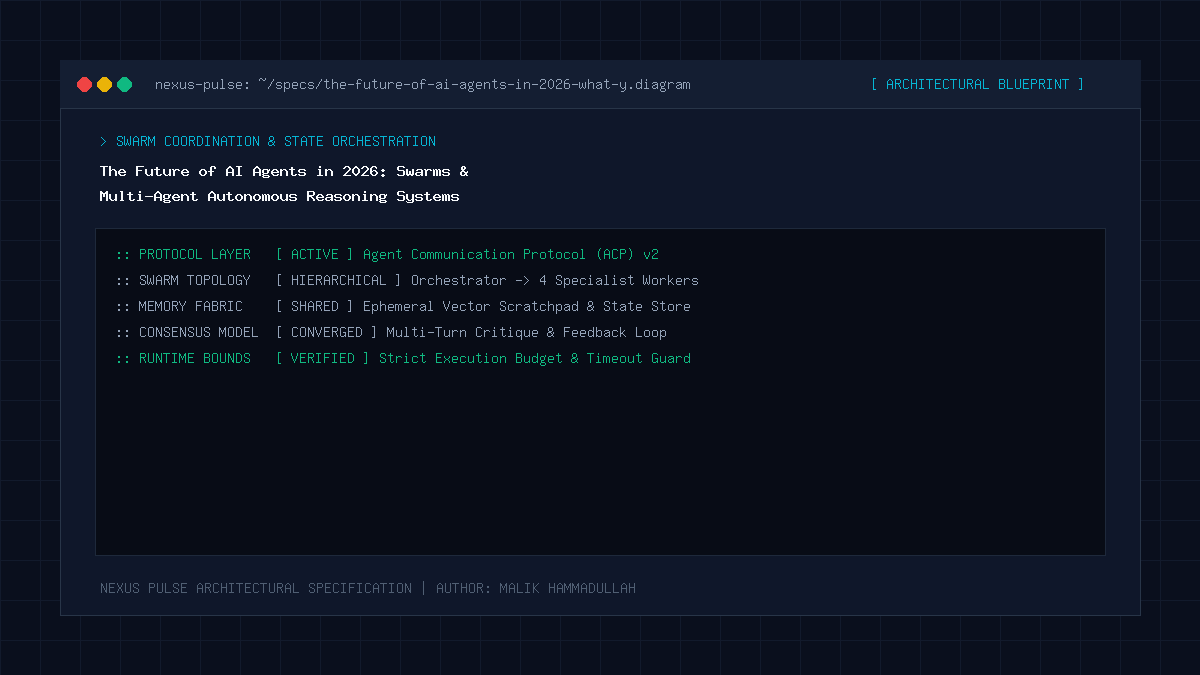
The future of AI agents in 2026 centers on multi-agent collaboration swarms, hierarchical task decomposition, dynamic memory graphs, and test-time compute scaling, enabling autonomous systems to execute complex workflows over days rather than seconds.
Key Takeaways & Quick Summary
- Single-prompt agents have been superseded by specialized multi-agent swarms with distinct operational roles.
- Hierarchical planning architectures divide high-level user intents into deterministic, verifiable sub-tasks.
- Persistent memory graphs combine vector embeddings with relational graph databases for long-term state retention.
- Test-time compute scaling allows models to verify and self-correct their reasoning before initiating external tool calls.
Beyond Single-Turn Conversational Models
The evolution of artificial intelligence has transitioned rapidly from conversational chatbots to autonomous agents capable of independent multi-step problem solving. In 2026, leading software engineering and enterprise automation initiatives no longer interact with monolithic, single-turn language models; instead, they deploy coordinated swarms of specialized autonomous agents.
In a multi-agent swarm, individual agents are assigned discrete operational personas: a Project Manager agent decomposes high-level user specifications into structured issue backlogs; an Architect agent designs database schemas and API boundaries; multiple Engineer agents author modular implementations concurrently; and an Auditor agent executes linting, unit tests, and security penetration checks.
This separation of concerns mirrors human engineering organizations, dramatically reducing token context contamination and boosting problem resolution accuracy on complex multi-day objectives.
Hierarchical Planning & Task Decomposition
Early agentic systems suffered from cascading hallucination loops: an error in step two of a ten-step execution plan would compound, steering the agent into unproductive or destructive states. In 2026, modern frameworks employ hierarchical task trees with deterministic rollback capabilities.
Before executing any state-modifying action (such as writing to a database or executing a terminal command), the supervisor agent evaluates the proposed state transition against formal pre-conditions and post-conditions. If an action fails its automated verification test, the supervisor halts downstream branches and directs the sub-agent to generate an alternative remediation hypothesis.
This deterministic scaffolding transforms probabilistic language model reasoning into predictable, enterprise-grade software workflows.
Dynamic Memory Graphs & Context Persistence
Traditional vector database Retrieval-Augmented Generation (RAG) proved inadequate for multi-step agent reasoning due to the loss of temporal relationships and entity hierarchies. In 2026, state-of-the-art agents utilize hybrid memory architectures combining vector similarity search with structured knowledge graphs.
By maintaining explicit graph edges between entities—such as customer records, software modules, past pull requests, and organizational policies—agents can traverse multi-hop dependency queries without experiencing context degradation over long execution horizons.
Enterprise Deployment & Economic Viability
Deploying multi-agent swarms at enterprise scale requires rigorous cost governance. A single high-level objective assigned to a five-agent swarm can generate thousands of intermediate reasoning tokens. Organizations enforce token budgets, caching middleware, and local small language model (SLM) routing for low-complexity triage tasks.
By offloading routine categorization and data parsing to quantized 8B models and reserving 70B+ frontier reasoning models for complex architectural synthesis, enterprises achieve 80% operational cost reductions while sustaining maximum execution velocity.
The Future of AI Agents in 2026: Architecture & Technical Specifications Matrix
Evolutionary Comparison of AI Agent Architectures (2024 vs 2026):
| Dimension | 2024 Architecture | 2026 State-of-the-Art Architecture | Impact |
|---|---|---|---|
| Agent Topology | Single monolithic agent | Specialized multi-agent swarms | 5x higher accuracy on complex goals |
| Task Planning | Linear prompt chaining | Hierarchical tree decomposition with rollbacks | Eliminates cascading hallucination loops |
| Memory Architecture | Naive vector RAG chunks | Hybrid knowledge graphs + temporal episodic memory | Flawless multi-hop entity reasoning |
| Tool Execution | Direct unverified API calls | Deterministic schema validation & microVM sandboxing | Zero unauthorized execution exploits |
| Inference Scaling | Fixed pre-training compute | Dynamic test-time compute & reasoning scaling | Superhuman algorithmic self-correction |
Official Specifications & Primary Sources
Architectural specifications, model capabilities, and benchmark evaluations in this guide are cited from official documentation and published papers (verified as of October 2026):
- SWE-bench: SWE-bench Verified Software Engineering Benchmark
- Microsoft: Microsoft AutoGen Multi-Agent Framework (GitHub)
- OpenAI: OpenAI Swarm Multi-Agent Orchestration Framework
The Future of AI Agents in 2026: Engineering Questions & Practical Considerations
What is a multi-agent swarm in software development?
A multi-agent swarm is a network of specialized AI agents working cooperatively—such as an architect, coder, tester, and reviewer—passing structured messages to achieve a unified engineering goal.
How do agents maintain context across long projects?
Modern agents use hybrid memory graphs that combine vector embeddings with relational graph databases to retain architectural decisions and temporal changes across months of project development.
Are multi-agent systems safe for production deployment?
Only when paired with strict sandboxing, egress network firewalls, deterministic schema validation, and human-in-the-loop approvals for sensitive state changes.
Join Our Official WhatsApp Channel
Get instant notifications for breaking AI developments, developer security guides, and tech intelligence directly on WhatsApp.

Recommended Reading