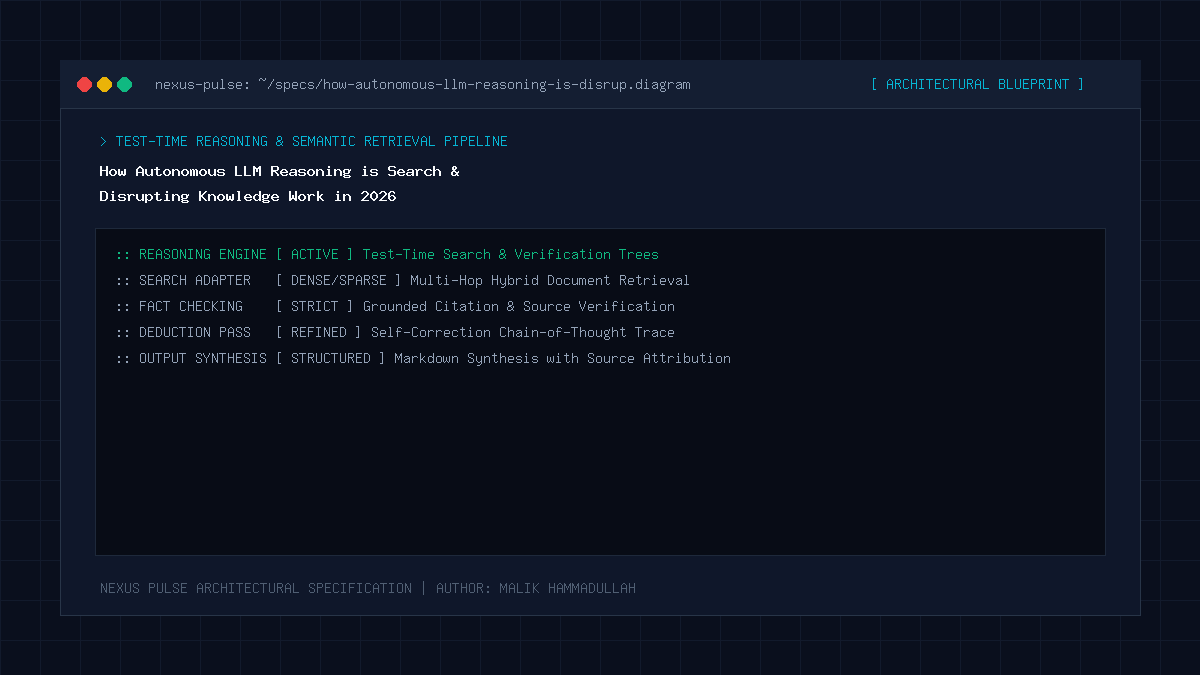
Autonomous LLM reasoning models scale computational effort dynamically at inference time, synthesising disparate research papers, regulatory filings, and private databases into verified answers with verifiable source citations, replacing traditional ten-blue-links search.
Key Takeaways & Quick Summary
- Test-time compute scaling allows models to deliberate and self-correct before presenting conclusions.
- Traditional keyword indexing is being replaced by semantic synthesis engines capable of multi-step research.
- Autonomous research agents execute recursive web searches, verifying contradictory claims across sources.
- Enterprise knowledge workers save up to 12 hours weekly by delegating literature reviews to reasoning networks.
The Death of the Ten Blue Links
For over a quarter of a century, information retrieval on the internet was governed by a single paradigm: enter a string of keywords into an input box, and receive a ranked list of ten blue links. In 2026, that paradigm is collapsing under the weight of autonomous LLM reasoning systems.
Modern knowledge workers—lawyers, financial analysts, software architects, and medical researchers—no longer have the patience to click through search results, navigate banner ads, and cross-reference contradictory blog posts manually. Instead, platforms like Perplexity Pro, OpenAI Deep Research, and DeepSeek R1 synthesize authoritative, multi-source intelligence briefings in seconds.
This transition marks the evolution from information retrieval to autonomous knowledge synthesis.
The Mechanics of Test-Time Compute Scaling
The breakthrough driving this disruption is test-time compute scaling. Unlike traditional language models that output the most probable next token immediately, reasoning models deliberate internally before generating user-facing text.
When presented with a complex query—such as evaluating the tax implications of cross-border intellectual property transfers across three jurisdictions—the model explores multiple hypothesis trees, executes targeted search queries to fill factual gaps, identifies logical inconsistencies in its own draft conclusions, and refines its response until it meets internal confidence thresholds.
This computational scaling transforms language models from probabilistic autocomplete tools into rigorous analytical research engines.
Verification, Citations & Hallucination Mitigation
The primary historical objection to AI-driven search was the risk of hallucinations. In 2026, autonomous search agents mitigate this vulnerability through real-time citation grounding. Every factual claim is tied cryptographically to specific URLs, PDF page numbers, or database records.
Furthermore, automated reflection passes compare the generated claim against the cited source text, pruning any statement that lacks verifiable empirical backing before presenting the final brief to the user.
Enterprise Knowledge Silos & Private Semantic Search
Beyond the public web, the largest commercial opportunity for autonomous reasoning lies within private enterprise data silos. By indexing internal Notion workspaces, Jira tickets, Slack archives, and Google Drive repositories into semantic vector graphs, employees query company intelligence with conversational precision.
An engineer can ask, “Why did our distributed payment service fail during the Black Friday load spike two years ago?” and receive a comprehensive root-cause analysis citing the exact post-mortem doc, PR merge commit, and Datadog alert log.
How Autonomous LLM Reasoning is Disrupting Search & Knowledge Work in 2026: Architecture & Technical Specifications Matrix
Traditional Search vs Autonomous Reasoning Search Engines (2026 Comparison):
| Feature | Traditional Search (Google) | Autonomous Reasoning (Perplexity/R1) |
|---|---|---|
| Interaction Model | Keyword query -> 10 blue links | Conversational query -> Direct synthesized answer |
| Information Synthesis | Manual user reading & cross-referencing | Automated multi-source extraction & verification |
| Complex Problem Solving | Incapable of multi-step logical deduction | Recursive planning & test-time compute scaling |
| Citation Integrity | SEO-manipulated ad placements | Grounded academic & technical source citations |
| Enterprise Productivity | 30-45 minutes per research topic | 2-3 minutes for comprehensive intelligence brief |
Official Specifications & Primary Sources
Architectural specifications, model capabilities, and benchmark evaluations in this guide are cited from official documentation and published papers (verified as of October 2026):
- DeepSeek: DeepSeek R1 Architecture & Research Paper (GitHub)
- OpenAI: OpenAI Reasoning Models Documentation
- Anthropic: Anthropic Extended Thinking Documentation
How Autonomous LLM Reasoning is Disrupting Search & Knowledge Work in 2026: Engineering Questions & Practical Considerations
What is test-time compute scaling in AI reasoning?
Test-time compute scaling allows an AI model to spend dynamic computational time “thinking” and verifying its logic before outputting answers, dramatically reducing hallucinations.
Will AI search engines destroy traditional web publishers?
Publishers with shallow, generic content are seeing traffic decline, but authoritative technical publications that offer unique empirical benchmarks and primary data earn higher attribution citations in AI summaries.
How can businesses optimize their websites for AI reasoning search?
By providing structured data tables, clear direct answers near headings, original data, and comprehensive E-E-A-T credentials that AI crawlers can verify.
Join Our Official WhatsApp Channel
Get instant notifications for breaking AI developments, developer security guides, and tech intelligence directly on WhatsApp.

Recommended Reading