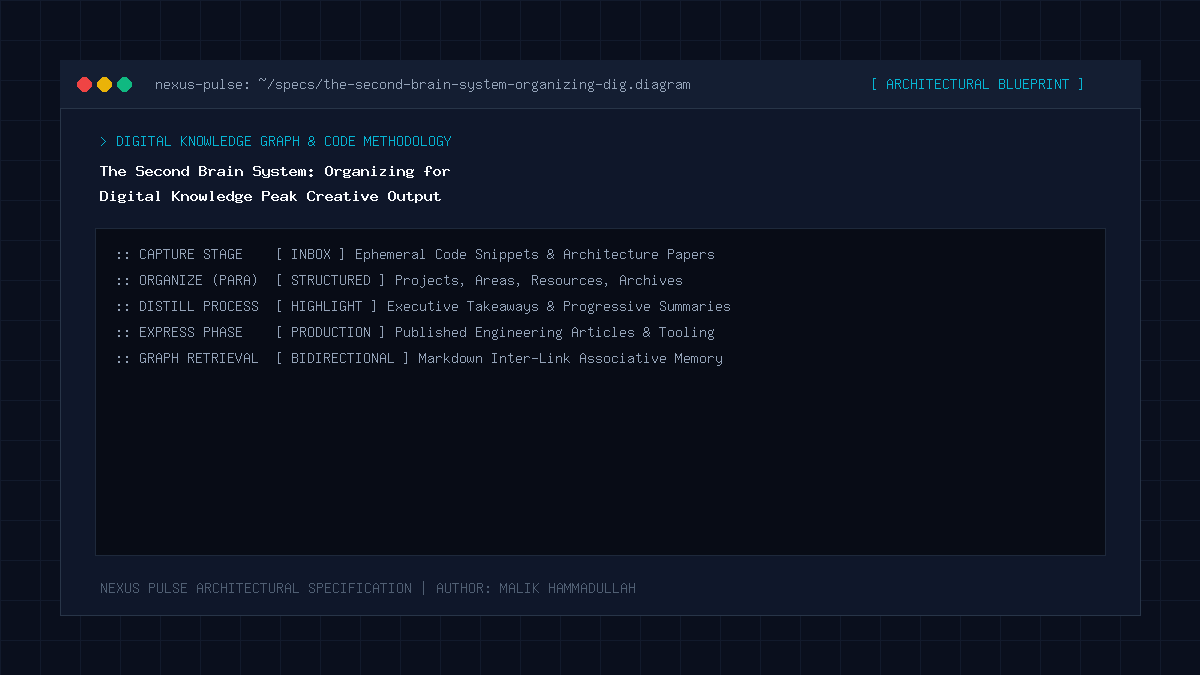
A Second Brain is an external, decentralized digital knowledge repository built on plain-text markdown, bi-directional linking (Obsidian), and the P.A.R.A. organizational methodology, designed to offload biological memory and compound creative intellectual output over a lifetime.
Key Takeaways & Quick Summary
- Your brain is for having ideas, not for storing them: offloading knowledge reduces cognitive load.
- The P.A.R.A. method organizes information by actionability (Projects, Areas, Resources, Archives) rather than topic.
- Bi-directional graph linking unlocks unexpected serendipitous connections across disparate technical disciplines.
- Plain-text local markdown files ensure that your personal knowledge repository survives proprietary cloud shutdowns.
The Problem of Digital Amnesia
As knowledge workers, we consume staggering amounts of high-value information every day: complex engineering documentation, research papers, book highlights, architectural teardowns, and podcast insights. Yet, within forty-eight hours, the human brain forgets over 80% of what it consumed—a phenomenon known as the Ebbinghaus Forgetting Curve.
When the time comes to architect a new cloud infrastructure, author an authoritative technical guide, or pitch an investor, we find ourselves frantically searching through browser bookmarks, lost Notion pages, and buried Slack threads trying to rediscover that brilliant insight we encountered six months ago.
Building a “Second Brain” solves digital amnesia. By systematically capturing, curating, and connecting digital knowledge in a centralized external repository, you transform fleeting information consumption into compounding, lifelong creative capital.
The P.A.R.A. Method: Organizing for Actionability
The most common failure in personal knowledge management is organizing notes by broad academic topics (e.g., “Computer Science,” “Economics,” “Design”). These categories become digital dumping grounds where notes go to die because they lack immediate operational context.
Pioneered by productivity expert Tiago Forte, the P.A.R.A. framework organizes all digital files into four distinct categories based on their immediate actionability:
Projects: Active initiatives with a defined deadline and outcome (e.g., “Deploy LiteSpeed Cache Theme v1.2”).
Areas: Ongoing spheres of operational responsibility that require continuous maintenance (e.g., “Health & Fitness,” “Financial Investments,” “Server Infrastructure”).
Resources: Topic libraries, templates, and research references that may be useful in future projects (e.g., “Prompt Injection Payloads,” “CSS Grid Snippets”).
Archives: Inactive items from the previous three categories retained for historical recordkeeping.
Networked Thought & Bi-Directional Graph Linking
Hierarchical folder structures force ideas into rigid, arbitrary silos. In the real world, innovative ideas live at the intersections of disparate fields: quantum physics informs cybersecurity; behavioral psychology informs frontend typography.
Modern Second Brain systems utilize networked thought powered by bi-directional markdown links (popularized by tools like Obsidian and Logseq). By typing `[[Concept Name]]`, you create a living synaptic connection between two independent notes.
Over months of note-taking, an interactive, multi-dimensional knowledge graph emerges, automatically surfacing surprising connections and sparking novel creative insights.
Plain-Text Markdown Sovereignty & Longevity
Never entrust your life’s intellectual work to proprietary cloud silos that lock your data behind custom database formats (such as early Evernote or closed SaaS apps). If the company goes bankrupt, changes its pricing, or suffers an outage, your knowledge is held hostage.
An elite Second Brain is built on local, plain-text Markdown (`.md`) files stored directly on your own hard drive. Markdown is an open, universal standard that will remain human-readable and machine-parsable fifty years from today, immune to vendor lock-in.
The Second Brain System: Architecture & Technical Specifications Matrix
The 4 Tiers of the P.A.R.A. Knowledge Management System:
| P.A.R.A. Category | Definition & Purpose | Time Horizon | Example Note |
|---|---|---|---|
| Projects | Active goals with a specific deadline and binary completion criteria | Short-term (1-4 weeks) | Launch New B2B SaaS Landing Page |
| Areas | Ongoing standards and domains of continuous responsibility | Perpetual / Indefinite | Server DevOps & Database Backups |
| Resources | Reference topics, research papers, and reusable toolkits | Long-term / On-demand | NIST Post-Quantum Cryptography Papers |
| Archives | Completed projects, dormant areas, and historical logs | Cold Storage / Inactive | Completed 2025 Tax Returns & Audits |
Official Specifications & Primary Sources
Architectural specifications, model capabilities, and benchmark evaluations in this guide are cited from official documentation and published papers (verified as of October 2026):
The Second Brain System: Engineering Questions & Practical Considerations
What is the best app for building a Second Brain?
Obsidian is the undisputed favorite among developers and technical researchers due to its local markdown storage, bi-directional graph view, zero telemetry, and massive open-source plugin ecosystem.
How much time does it take to maintain a Second Brain?
Less than 15 minutes a day. By adopting progressive summarization and quick-capture shortcuts, knowledge management becomes a seamless part of your daily research workflow rather than a chore.
What is progressive summarization?
It is a multi-layer note distillation technique: Layer 1 is the raw captured excerpt; Layer 2 is bolded key phrases; Layer 3 is highlighted critical sentences; Layer 4 is an executive summary written in your own words.
Join Our Official WhatsApp Channel
Get instant notifications for breaking AI developments, developer security guides, and tech intelligence directly on WhatsApp.

Recommended Reading