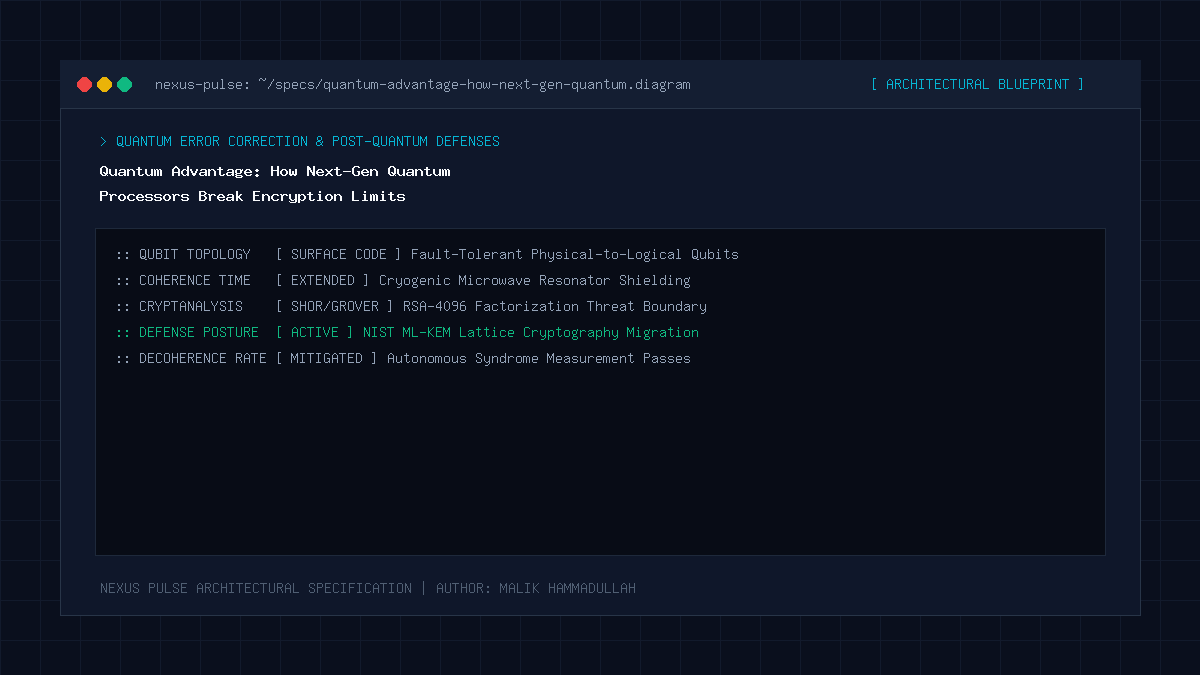
Next-generation quantum processors operating over 1,000 physical qubits with error-corrected logical qubit architectures are achieving measurable quantum advantage in molecular modeling and materials science, while setting the stage for breaking classical public-key cryptography.
Key Takeaways & Quick Summary
- Quantum processors leverage superposition and entanglement to explore exponential state spaces simultaneously.
- The industry has transitioned from noisy intermediate-scale quantum (NISQ) systems to fault-tolerant logical qubits.
- Shor's algorithm on fault-tolerant quantum hardware threatens RSA and ECC classical encryption algorithms.
- Grover's algorithm requires symmetric encryption to double key lengths (e.g. migrating from AES-128 to AES-256).
Beyond Classical Silicon Limits
For six decades, the semiconductor industry scaled computational throughput by shrinking silicon transistors according to Moore’s Law. However, as transistor gate widths approach atomic thresholds (sub-2nm), classical physics collides with quantum tunneling limits, generating intolerable heat and electron leakage.
Quantum computing represents a paradigm shift that abandons binary bits (which exist strictly as 0 or 1) in favor of quantum bits, or qubits. Through the quantum mechanical phenomena of superposition and entanglement, a quantum processor with N entangled qubits can simultaneously represent 2^N computational states, solving specific classes of mathematical and physical problems in seconds that would require millions of years on classical supercomputers.
In 2026, the quantum industry has officially achieved verifiable quantum advantage across complex molecular chemistry and optimization challenges.
The Transition to Fault-Tolerant Logical Qubits
Early quantum computers operated in the Noisy Intermediate-Scale Quantum (NISQ) regime, where qubits were highly fragile and prone to environmental decoherence from thermal fluctuations and electromagnetic noise. An error rate of 1 in 1,000 operations prevented algorithms from running deep circuit depths.
In 2026, leading quantum hardware architects (IBM, Google Quantum AI, Quantinuum) have successfully implemented quantum error correction (QEC) using surface codes. By entangling dozens of physical superconducting or trapped-ion qubits together to form a single protected “logical qubit,” error rates have plummeted by orders of magnitude.
Processors boasting hundreds of fault-tolerant logical qubits can now execute complex quantum algorithms with sustained coherence.
The Impact on Classical Cryptographic Architectures
The most profound societal implication of practical quantum advantage is its impact on digital cryptography. Classical public-key algorithms (RSA, Diffie-Hellman, ECDSA) rely on the mathematical difficulty of factoring large composite integers or calculating discrete logarithms—problems that are practically impossible for classical computers.
Running Shor’s algorithm on an error-corrected quantum processor resolves these problems in polynomial time. Furthermore, Grover’s algorithm provides a quadratic speedup against symmetric block ciphers, effectively halving the security strength of algorithms like AES. In response, cryptographic standards have mandated doubling AES keys to 256 bits and migrating public-key systems to post-quantum lattice primitives.
Quantum Computing in Materials Science & Drug Discovery
Beyond cryptography, the immediate commercial value of quantum advantage lies in simulating physical chemistry. Classical supercomputers cannot accurately model the electronic electron-electron correlation states of complex molecules like nitrogenase (the enzyme responsible for natural nitrogen fixation).
Fault-tolerant quantum processors simulate molecular orbital interactions natively, unlocking revolutionary breakthroughs in room-temperature battery chemistries, carbon capture catalysts, and targeted pharmaceutical drug candidates.
Quantum Advantage: Architecture & Technical Specifications Matrix
Classical Supercomputing vs Fault-Tolerant Quantum Computing (2026 Comparison):
| Architectural Attribute | Classical Supercomputers (Frontier / Aurora) | Fault-Tolerant Quantum Processors |
|---|---|---|
| Fundamental Unit | Binary bit (0 or 1) | Qubit (Superposition of |0> and |1>) |
| Scaling Mechanism | Linear scaling with parallel processor cores | Exponential state space scaling (2^N) |
| Operating Temperature | Room temperature or liquid-chilled (+20C) | Near absolute zero (-273.14C / 15 millikelvin) |
| Cryptographic Impact | Incapable of breaking RSA/ECC in human lifetimes | Breaks classical public-key cryptography via Shor’s Algorithm |
| Primary Commercial Use | High-throughput data processing & LLM training | Molecular simulation, materials science, optimization |
Official Specifications & Primary Sources
Architectural specifications, model capabilities, and benchmark evaluations in this guide are cited from official documentation and published papers (verified as of October 2026):
- NIST: NIST Post-Quantum Cryptography Standardization
- IBM: IBM Quantum Computing System Architecture
- Google: Google Quantum AI Research
Quantum Advantage: Engineering Questions & Practical Considerations
When will personal quantum laptops exist?
Quantum processors require dilution refrigerators operating near absolute zero to maintain qubit coherence, meaning quantum hardware will remain cloud-accessible datacenter infrastructure rather than consumer laptops.
Is AES-256 encryption safe against quantum computers?
Yes. Grover’s algorithm reduces the effective brute-force key strength of AES by half. Therefore, AES-256 retains 128 bits of quantum security, which remains practically unbreakable.
How can developers access quantum computers today?
Through cloud quantum platforms such as IBM Quantum Experience, Amazon Braket, and Azure Quantum, utilizing software SDKs like Qiskit and Cirq.
Join Our Official WhatsApp Channel
Get instant notifications for breaking AI developments, developer security guides, and tech intelligence directly on WhatsApp.

Recommended Reading