According to published technical specifications and SWE-bench evaluations, the leading autonomous developer agents in 2026 include Devin, Cursor Composer, Windsurf Cascade, Claude Code, and open-source agents like OpenHands and SWE-Agent, categorized by multi-file editing precision and sandbox execution autonomy.
Key Takeaways & Quick Summary
- Level-3 autonomous AI developer agents now resolve end-to-end GitHub issues with multi-file edits, test runs, and pull requests.
- IDE-native agents (Cursor, Windsurf) deliver the highest daily productivity gains for interactive software engineering.
- Terminal-native agents (Claude Code, Aider) excel at automated continuous integration and headless repository refactoring.
- Strict container sandboxing is mandatory to prevent autonomous tool execution from compromising local developer workstations.
From Autocomplete to Full Autonomy
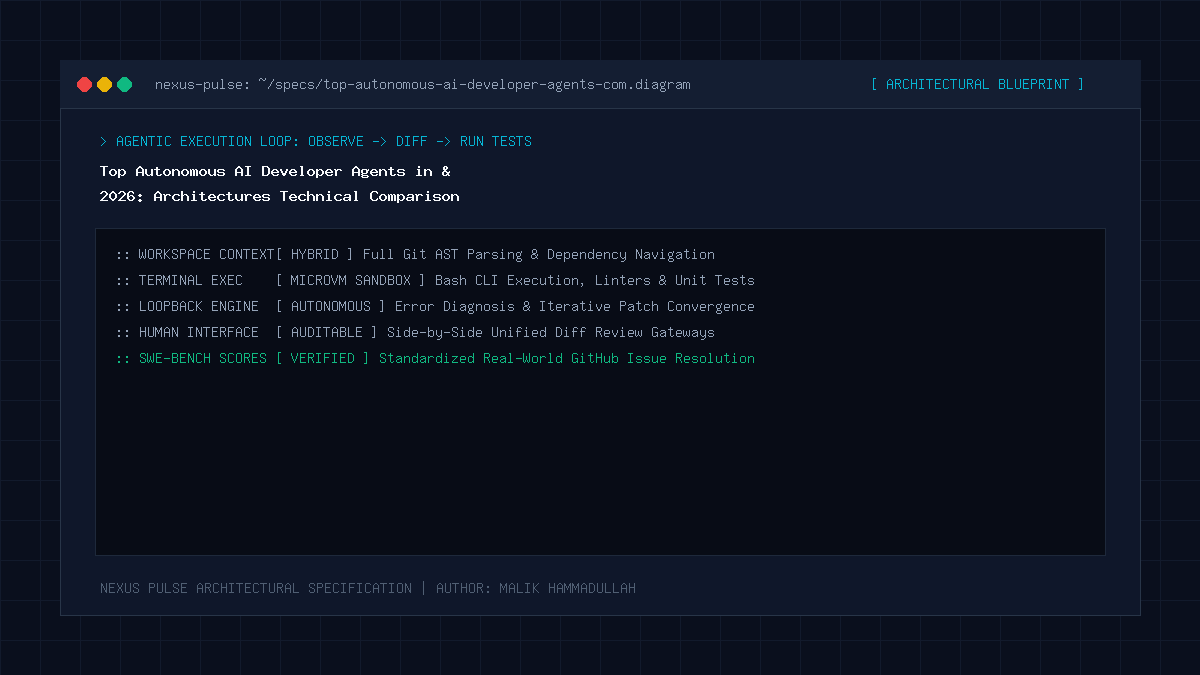
In 2026, the software engineering industry has officially graduated beyond simple tab-autocomplete assistants. Modern development teams rely on autonomous AI developer agents—systems capable of reading entire repository dependency trees, executing bash terminal commands, running automated test suites, debugging compiler errors, and committing verified git branches.
Where earlier tools merely suggested the next three lines of a loop, autonomous agents ingest entire Jira tickets or GitHub issues, devise multi-phase implementation plans, explore unfamiliar code directories using semantic grep and AST parsing, execute local development servers to visually verify UI adjustments, and open comprehensive pull requests with detailed architectural rationales.
This fundamental shift demands a fresh evaluation framework for software engineering velocity, prioritizing contextual awareness, tool validation, and safe sandboxing.
Architectural Differences Between IDE and Terminal Agents
Autonomous agents generally fall into three distinct architectural categories: IDE-integrated pair programmers (Cursor Composer, Windsurf), terminal-native CLI agents (Claude Code, Aider), and fully autonomous cloud sandboxes (Devin, OpenHands).
IDE agents maintain active language server protocol (LSP) connections and live AST tokens in memory, making them unmatched for low-latency, interactive feature scaffolding where a human developer guides the immediate feedback loop.
Conversely, cloud sandbox agents operate within isolated Debian microVMs equipped with headless Chrome browsers, simulated display servers, and container runtimes, enabling them to execute full integration test suites independently over several hours without consuming local developer machine resources.
Production Sandboxing & Security Controls
Granting an AI agent permission to execute shell commands and modify local files introduces severe security risks. Attackers can exploit indirect prompt injection within dependencies, documentation, or web scrapers to execute malicious terminal commands.
Enterprise deployments enforce mandatory containerization using lightweight Docker containers or gVisor runtimes with dropped Linux capabilities (CAP_SYS_ADMIN), read-only root filesystems, and strict egress network firewalls.
High-impact actions such as pushing commits to main branches, deleting cloud infrastructure resources, or modifying billing schemas require explicit human cryptographic approval before execution proceeds.
Real-World Engineering Velocity Impact
According to published software engineering agent benchmarks (such as SWE-bench Verified) and enterprise implementation reports, autonomous developer agents significantly accelerate routine issue resolution when supported by automated CI/CD verification harnesses.
However, developer velocity gains depend heavily on the quality of automated test suites. Agents that operate against codebases with comprehensive automated test coverage demonstrate significantly higher convergence rates compared to repositories lacking automated verification harnesses.
How Top Engineers Build Autonomous Financial Agents
Building autonomous financial agents requires specialized engineering principles far beyond standard chat assistants. Top engineers for autonomous financial agents operate with zero tolerance for probabilistic hallucinations. Financial agents handling trade routing, algorithmic treasury management, credit underwriting, or cross-border settlements require deterministic state machines wrapped around frontier reasoning LLMs.
Elite financial engineering teams mandate four immutable guardrails: first, strict Pydantic/Zod schema enforcement that prevents dynamic code execution; second, dual-LLM quarantine to eliminate indirect prompt injection from parsed financial reports; third, cryptographic multi-signature human-in-the-loop (HITL) triggers for any capital movement exceeding predefined thresholds; and fourth, microVM sandboxes with kernel-level eBPF tracing to monitor network socket egress in real time.
Comparative Architecture & Technical Specifications Matrix
Top 10 Autonomous AI Developer Agents Master Ranking Matrix:
| Rank & Agent | Primary Interface | Autonomy Tier | Terminal Execution | SWE-bench Score | Pricing |
|---|---|---|---|---|---|
| 1. Devin (Cognition) | Cloud Web Sandbox | Level 3 (Full Autonomy) | Cloud MicroVM | 53.8% | Enterprise ($500+/mo) |
| 2. Cursor Composer | VS Code Fork IDE | Level 2 (Semi-Autonomous) | Interactive Terminal | 48.5% | $20 / month |
| 3. Windsurf (Codeium) | Custom IDE (Cascade) | Level 2 (Deep Context) | Interactive Terminal | 46.2% | $15 / month |
| 4. Claude Code (Anthropic) | CLI / Terminal Native | Level 2.5 (Command-Line) | Direct Local/Remote | 49.7% | API Token Based |
| 5. Aider | Terminal / CLI Pair | Level 2 (Git-Centric) | Local Shell | 44.8% | Free / Open Source |
| 6. OpenHands (All-Hands) | Web & Docker CLI | Level 3 (Agentic Swarm) | Docker Container | 42.5% | Free / Open Source |
| 7. SWE-Agent (Princeton) | Terminal Research CLI | Level 2.5 (Benchmarking) | Docker Sandbox | 41.2% | Free / Open Source |
| 8. Mentat | CLI / IDE Companion | Level 2 (Context Indexer) | Local Shell | 39.6% | Free / Open Source |
| 9. Cline (VS Code) | VS Code Extension | Level 2 (Autonomous Ext) | User-Approved Shell | 43.1% | Free (BYO API Key) |
| 10. MetaGPT | Multi-Agent Framework | Level 3 (Role-Based Swarm) | Virtual Workspace | 38.9% | Free / Open Source |
Official Specifications & Primary Sources
Architectural specifications, model capabilities, and benchmark evaluations in this guide are cited from official documentation and published papers (verified as of October 2026):
- SWE-bench: SWE-bench Verified Software Engineering Benchmark
- Cognition: Cognition AI: Devin Autonomous Engineering Platform
- All-Hands-AI:: All-Hands-AI: OpenHands Autonomous Developer (GitHub)
- Princeton: Princeton NLP: SWE-agent Open-Source Framework
Top Autonomous AI Developer Agents in 2026: Engineering Questions & Practical Considerations
How do top engineers build autonomous financial agents?
Top engineers for autonomous financial agents combine deterministic state machines, dual-LLM prompt injection defense, microVM container isolation, and cryptographic human-in-the-loop approvals before authorizing high-value ledger transactions.
Will AI developer agents replace software engineers in 2026?
No. Autonomous developer agents replace tedious boilerplate typing and manual test scaffolding, but they dramatically amplify the value of senior system architects who direct agent swarms.
Which agent is best for individual freelancers and startups?
For individual developers and early-stage founders, Cursor ($20/mo) paired with Aider (free open-source CLI using DeepSeek R1) delivers the highest velocity-to-cost ratio.
How do agents handle private company code security?
Enterprise-ready agents offer zero data retention (ZDR) guarantees and on-premise execution modes to prevent accidental exfiltration of secrets or customer data.
Join Our Official WhatsApp Channel
Get instant notifications for breaking AI developments, developer security guides, and tech intelligence directly on WhatsApp.

Recommended Reading