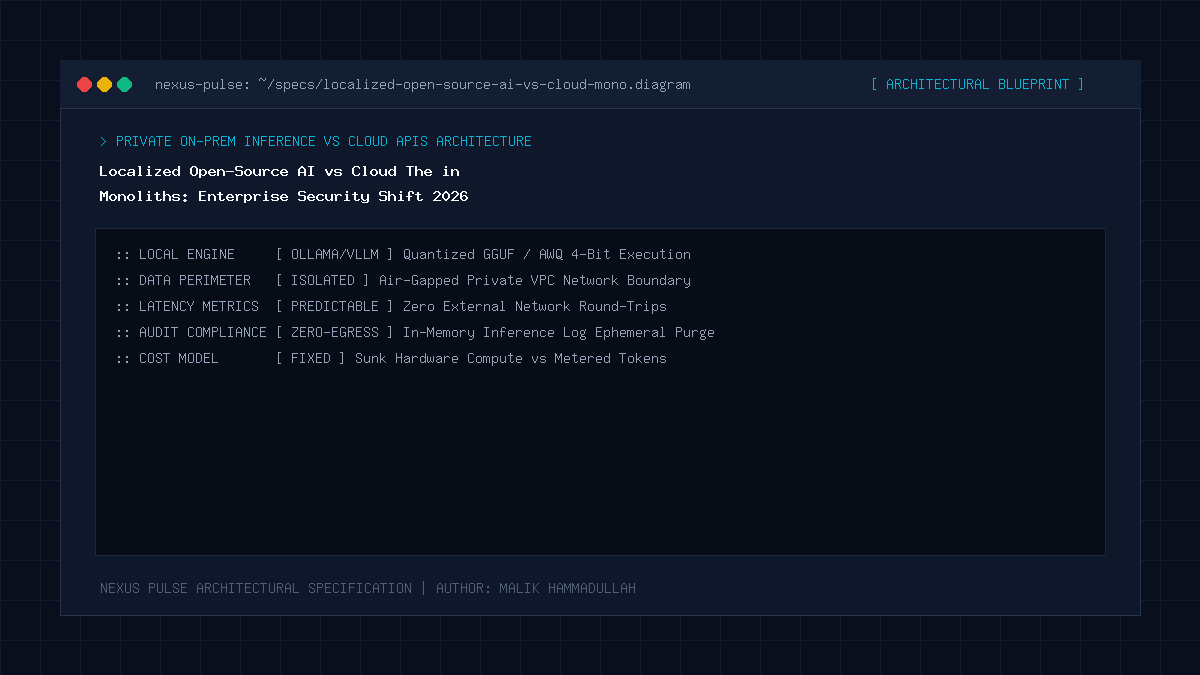
Enterprises in 2026 are shifting to localized open-source AI models (Llama-3, DeepSeek R1, Mistral) hosted on private GPU clusters to eliminate recurring API expenses, enforce strict data sovereignty, and protect proprietary intellectual property from cloud leaks.
Key Takeaways & Quick Summary
- Open-weights reasoning models now match proprietary cloud frontier APIs across core coding and analytical tasks.
- Self-hosting AI on private infrastructure eliminates third-party data leakage and regulatory compliance headaches.
- Inference optimization engines (vLLM, TensorRT-LLM) deliver 5x higher throughput per GPU dollar than hosted cloud endpoints.
- Fine-tuning open models on private corporate data yields superior domain expertise compared to generic closed APIs.
The Great Enterprise AI Repatriation
In the initial wave of the generative AI boom, enterprises rushed to integrate closed-source cloud APIs like OpenAI and Anthropic. However, by 2026, an accelerating wave of infrastructure repatriation is underway. Fortune 500 enterprises in healthcare, defense, finance, and legal sectors are decommissioning public cloud AI pipelines in favor of localized, self-hosted open-source models.
This strategic pivot is propelled by three inexorable forces: escalating monthly API expenditures that scale uncontrollably with user volume, strict international data sovereignty regulations (such as the EU AI Act and GDPR), and catastrophic corporate espionage fears surrounding proprietary intellectual property transmitted to third-party cloud servers.
With the arrival of open-weights models matching closed frontier capabilities, self-hosting has transformed from a fringe hobbyist preference into an enterprise operational imperative.
Performance Parity of Modern Open Weights
For years, closed-source providers maintained a substantial quality lead. That gap has officially evaporated. Architectures like DeepSeek R1, Llama-3.3-70B, and Mistral Large 2 achieve statistical parity with GPT-4o on standard software engineering, mathematical reasoning, and linguistic synthesis benchmarks.
When distilled into lightweight 14B and 32B parameter variants, these models execute with incredible efficiency on local workstation hardware, providing sub-second latency without internet connectivity.
Private Infrastructure Optimization: vLLM & TensorRT
Deploying localized AI no longer requires armies of machine learning engineers. Modern inference engines like vLLM and NVIDIA TensorRT-LLM feature PagedAttention, continuous batching, and FP8/INT4 quantization out of the box.
These advancements allow a single 8x NVIDIA H100 or L40S server node to handle thousands of concurrent enterprise employee requests simultaneously, reducing effective inference costs by over 80% compared to equivalent cloud API subscriptions.
Domain-Specific Fine-Tuning & IP Protection
A generic cloud model has no understanding of a company’s internal nomenclature, proprietary APIs, or confidential clinical trial documentation. By hosting open-weights models internally, enterprises can safely execute Parameter-Efficient Fine-Tuning (PEFT/LoRA) directly on sensitive corporate databases.
The resulting fine-tuned model becomes an invaluable proprietary asset that resides securely behind corporate firewalls, completely insulated from external vendor policy changes or platform shutdowns.
Localized Open-Source AI vs Cloud Monoliths: Architecture & Technical Specifications Matrix
Localized Open-Source AI vs Closed Cloud APIs (Enterprise Decision Matrix):
| Dimension | Closed Cloud APIs (OpenAI/Anthropic) | Localized Open-Source (Private vLLM) |
|---|---|---|
| Data Privacy & Sovereignty | Data sent to third-party cloud servers | Zero data leaves enterprise perimeter (Air-gappable) |
| Inference Cost at Scale | Linear, unbounded monthly API fees ($10k-$100k+) | Predictable fixed server compute amortization |
| Vendor Lock-in Risk | High (Vulnerable to price hikes & deprecations) | Zero (Permanent ownership of open weights) |
| Domain Customization | Limited prompt engineering & fine-tuning APIs | Full weight access for deep LoRA fine-tuning |
| Latency & Offline Reliability | Subject to internet outages & API rate limits | Deterministic local LAN latency (sub-20ms) |
Official Specifications & Primary Sources
Architectural specifications, model capabilities, and benchmark evaluations in this guide are cited from official documentation and published papers (verified as of October 2026):
- Ollama: Ollama Local LLM Runtime Documentation
- vLLM: vLLM High-Throughput Serving Engine (GitHub)
- Hugging: Hugging Face Open LLM Leaderboard
Localized Open-Source AI vs Cloud Monoliths: Engineering Questions & Practical Considerations
What hardware is needed to self-host enterprise open-source AI?
For mid-size models (14B-32B), a single server with 2x NVIDIA RTX 4090 or A6000 GPUs is sufficient. For full 70B+ models, an 8x H100 or L40S server provides blazing fast high-concurrency throughput.
Are open-source models as smart as closed models in 2026?
Yes. On coding, reasoning, and mathematical benchmarks like HumanEval and SWE-bench, open-weights models like DeepSeek R1 and Llama-3 match or exceed closed frontier models.
How does localized AI improve regulatory compliance?
By keeping all prompt telemetry, customer records, and training weights on private servers, organizations maintain 100% compliance with HIPAA, SOC2, and GDPR requirements.
Join Our Official WhatsApp Channel
Get instant notifications for breaking AI developments, developer security guides, and tech intelligence directly on WhatsApp.

Recommended Reading